Introduction
The sum of numbers from \(1\) to \(100\) may look like a long and tiring calculation at first. Many students think they need to add every number one by one.
However, there is a much faster way. By spotting a simple pattern, students can solve the question in seconds. This method is often linked to the famous mathematician Carl Friedrich Gauss, who reportedly noticed the shortcut as a child.
For PSLE Maths students, this is a useful reminder that strong problem solving is not only about working harder. Sometimes, it is about seeing the pattern more clearly.
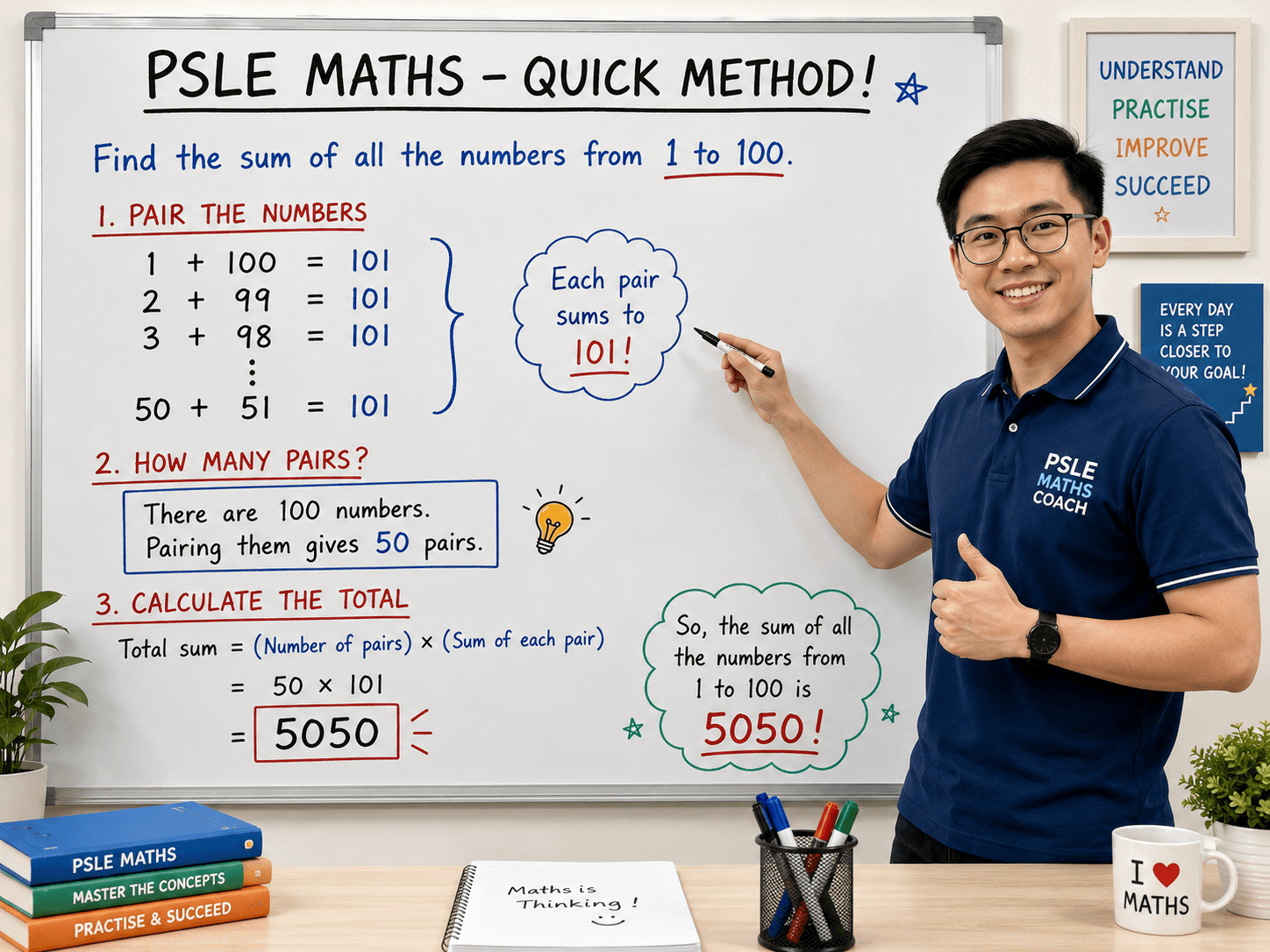
The Question / Scenario Explanation
Source: \(1 + 2 + 3 \dots + 100\) in 10 sec? A 7-year-old solved it in the 1780s.
The question is:
\(1 + 2 + 3 + \dots + 100\)
Instead of adding every number individually, we can pair the first number with the last number:
\(1 + 100 = 101\)
Then pair the next two numbers:
\(2 + 99 = 101\)
Then:
\(3 + 98 = 101\)
Every pair gives the same total, which makes the calculation much faster.
Step-by-Step Solution / Explanation
Step 1: Write the Sum Clearly
We want to find:
\(1 + 2 + 3 + \dots + 100\)
This means adding all the whole numbers from \(1\) to \(100\).
Step 2: Pair the First and Last Numbers
Now match the smallest number with the largest number:
\(1 + 100 = 101\)
\(2 + 99 = 101\)
\(3 + 98 = 101\)
\(4 + 97 = 101\)
Each pair adds up to:
\(101\)
Step 3: Find the Number of Pairs
There are \(100\) numbers altogether.
If we group them into pairs of \(2\), then the number of pairs is:
\(100 \div 2 = 50\)
So there are:
\(50\) pairs
Step 4: Multiply the Number of Pairs by the Sum of Each Pair
Each pair gives \(101\), and there are \(50\) pairs.
So the total is:
\(50 \times 101 = 5050\)
Final Answer: \( \boxed{5050} \)
Step 5: Try the Same Method for 1 to 50
The video also challenges students to find:
\(1 + 2 + 3 + \dots + 50\)
Use the same idea.
Pair the first and last numbers:
\(1 + 50 = 51\)
\(2 + 49 = 51\)
\(3 + 48 = 51\)
Each pair sums to:
\(51\)
There are:
\(50 \div 2 = 25\)
pairs.
So:
\(25 \times 51 = 1275\)
Therefore:
\(1 + 2 + 3 + \dots + 50 = 1275\)
Step 6: Understand the General Pattern
This pattern works because the first and last numbers always make the same total, the second and second-last numbers make the same total, and so on.
For \(1\) to \(100\):
each pair gives:
\(101\)
For \(1\) to \(50\):
each pair gives:
\(51\)
In general, when adding numbers from \(1\) to \(n\), students can often think in terms of equal pairs instead of repeated addition.
Key Concepts Students Must Know
- Pattern recognition: The fastest solutions often come from spotting a repeated structure.
- Pairing method: Matching the first and last numbers helps create equal sums.
- Equal groups: Once each pair has the same total, multiplication can replace long addition.
- Number of pairs: Divide the total number of terms by \(2\) to find how many pairs there are.
- Mental efficiency: Maths is not always about doing more work. It is often about doing the work more cleverly.
This is why the sum of numbers question is a great example of mathematical thinking.
Exam Tips / Common Mistakes
Exam Tips
- When you see a long sequence of consecutive numbers, check whether a pattern or pairing method can simplify it.
- Write one or two example pairs first to confirm the repeated total.
- Count the number of terms carefully before finding the number of pairs.
- Use multiplication only after confirming that every pair gives the same result.
- Practise this method on smaller sums first, such as \(1\) to \(10\) or \(1\) to \(20\).
Common Mistakes
- Counting the wrong number of pairs: For \(1\) to \(100\), there are \(50\) pairs, not \(100\) pairs.
- Using the wrong pair total: \(1 + 100 = 101\), not \(100\).
- Mixing up the challenge question: For \(1\) to \(50\), each pair totals \(51\), not \(101\).
- Adding one by one unnecessarily: This takes longer and increases the chance of careless mistakes.
- Applying the method without checking: Students should confirm that the numbers really form a consecutive sequence.
Parent Insight
Questions like this are valuable because they show children that Maths is not just about speed or memorisation. It is also about noticing patterns and choosing an efficient method.
Some students may think they are “not good at Maths” because they try to solve everything using only the most basic method. But when they learn to look for structure, they often realise that difficult questions can become much easier.
Parents can support this by asking, “Do you notice a pattern?” or “Is there a smarter way to group the numbers?” This helps children become more observant and more confident problem solvers.
Conclusion
To find the sum of numbers from \(1\) to \(100\), we pair the first and last numbers:
\(1 + 100 = 101\)
\(2 + 99 = 101\)
Each pair gives \(101\), and there are \(50\) pairs.
So the total is:
\(50 \times 101 = 5050\)
This method is simple, fast and a great example of how pattern recognition can turn a long calculation into an easy one.
Visit our PSLE Maths homepage: Explore PSLEMathsTuition
Read more PSLE Maths guides: Visit Our PSLE Maths Blog
Start here (limited slots weekly):
Free Trial: Click Here…
Enrol: Click Here…
Explore our main tuition brand approach here: Click Here…