Introduction
This star pattern question is a simple but important lower primary Maths question that tests grouping and multiplication thinking. Many students look at all the stars at once and get confused, but once we group them correctly, this star pattern question becomes very easy to solve.
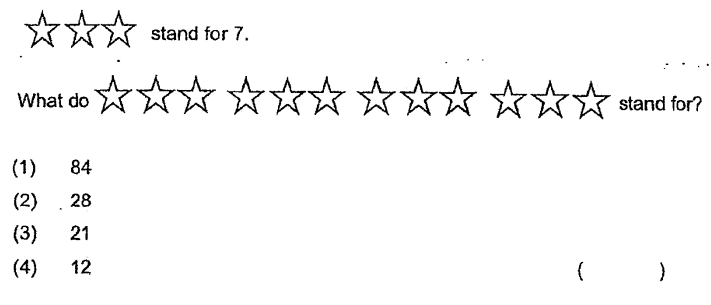
The Question / Scenario Explanation
Source: P3 MAHA BODHI 2023 Term 1
\(3\) stars stand for \(7\).
What do \(12\) stars stand for?
Step-by-Step Solution / Explanation
Step 1: Identify the basic group
We are told that \(3\) stars stand for \(7\).
So one group of \(3\) stars \(= 7\).
This is the key idea in the star pattern question.
Step 2: Count how many equal groups there are
The second line shows \(12\) stars altogether.
Now group them into sets of \(3\):
\(12 \div 3 = 4\)
So there are \(4\) equal groups.
Step 3: Find the total value
Each group stands for \(7\).
Since there are \(4\) groups:
\(7 \times 4 = 28\)
✅ Final Answer: \(28\)
Step 4: Quick check
If \(3\) stars \(= 7\), then \(4\) groups of \(3\) stars should be:
\(4 \times 7 = 28\)
This matches our answer, so the star pattern question is solved correctly.
Key Concepts Students Must Know
- In a star pattern question, always find the value of one equal group first.
- If the same group repeats, multiplication is often the fastest method.
- Count carefully to see how many equal groups are shown.
- Pattern questions often test grouping, repeated addition, and basic multiplication.
Exam Tips / Common Mistakes
Exam Tips
- Circle the basic group first before doing any calculation.
- Count how many times the group repeats.
- Use multiplication when the groups are equal.
- For a star pattern question, check whether the total picture is made of the same small group repeated several times.
Common Mistakes
- Counting the stars wrongly and using the wrong number of groups.
- Adding \(7 + 3\) instead of multiplying by the number of groups.
- Forgetting that \(3\) stars is one group, not one star.
- Choosing an answer based on guessing instead of grouping clearly.
Parent Insight
This star pattern question may look easy, but it builds strong early Maths habits. Children learn to look for equal groups, connect pictures to numbers, and apply multiplication meaningfully. These are important foundations for harder word problems and model-based thinking in upper primary.
Conclusion
To solve this star pattern question, we first noted that \(3\) stars stand for \(7\). Then we counted \(12\) stars as \(4\) equal groups of \(3\). Finally, we worked out \(7 \times 4 = 28\). So the correct answer is \(28\).
Visit our PSLE Maths homepage: Click Here…
Read more PSLE Maths worked examples here: Click Here…
Start here (limited slots weekly):
Free Trial: Click Here…
Enroll: Click Here…
Explore our main tuition brand approach here: Click Here… .