Introduction
This PSLE coin problem became widely discussed because the question looks complicated even though the solution can be surprisingly short once students notice one important clue: Helen and Ivan have the same total number of coins.
The question compares 20-cent and 50-cent coins. Instead of trying to find exactly how many 50-cent coins each person has, students can focus only on the difference between Helen’s and Ivan’s coin combinations.
This is a useful PSLE Maths problem-solving technique: when two totals are equal, identify what is different and compare only those remaining parts.
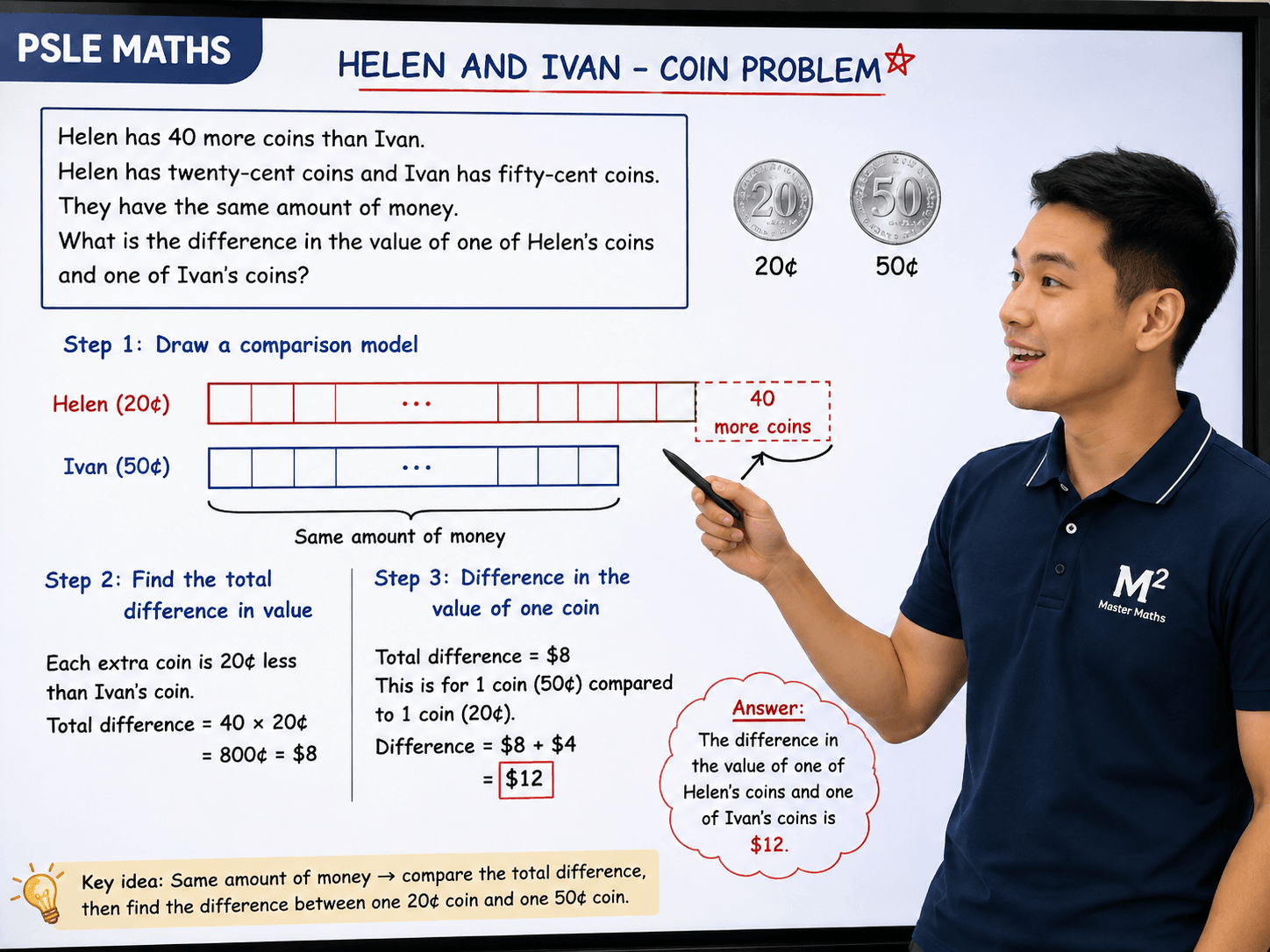
The Question / Scenario Explanation
Source: The PSLE question so viral, IKEA, DBS and Grab turned it into ads.
The question states:
“Helen and Ivan each have the same number of coins.”
“Helen has 64 twenty-cent coins and some fifty-cent coins.”
“Ivan has 104 twenty-cent coins and some fifty-cent coins.”
“Who has more money, and by how much?”
The most important sentence is:
Helen and Ivan each have the same number of coins.
This tells us that even though Ivan has more 20-cent coins, Helen must have more 50-cent coins to keep their total number of coins equal.
Step-by-Step Solution / Explanation
Step 1: Focus on the Equal Number of Coins
Helen and Ivan have the same total number of coins.
Helen has:
\(64\) twenty-cent coins
Ivan has:
\(104\) twenty-cent coins
Find the difference:
\(104 – 64 = 40\)
So Ivan has \(40\) more 20-cent coins than Helen.
Step 2: Use the Equal-Total Condition
Since Helen and Ivan have the same number of coins, Ivan’s extra \(40\) twenty-cent coins must be balanced by Helen having \(40\) more fifty-cent coins.
Therefore:
Ivan has \(40\) more 20-cent coins.
Helen has \(40\) more 50-cent coins.
This is the key relationship in the PSLE coin problem.
Step 3: Compare the Value of the Two Coin Types
A 50-cent coin is worth more than a 20-cent coin.
Find the difference in value:
\(50\text{ cents} – 20\text{ cents} = 30\text{ cents}\)
Each of Helen’s \(40\) extra 50-cent coins contributes an additional \(30\) cents compared with Ivan’s corresponding 20-cent coin.
Step 4: Multiply by the 40-Coin Difference
There are \(40\) such coin differences.
\(40 \times 30\text{ cents} = 1200\text{ cents}\)
Convert cents to dollars:
\(1200\text{ cents} = \$12\)
Step 5: State the Final Answer
Since Helen has the greater number of 50-cent coins, she has more money.
Final Answer: \( \boxed{\text{Helen has \$12 more than Ivan.}} \)
Key Concepts Students Must Know
- Equal totals: Helen and Ivan have the same total number of coins.
- Compare the difference: \(104 – 64 = 40\), so Ivan has 40 more 20-cent coins.
- Balance the coin count: Helen must therefore have 40 more 50-cent coins.
- Compare coin values: \(50\text{ cents} – 20\text{ cents} = 30\text{ cents}\).
- Multiply the differences: \(40 \times 30\text{ cents} = \$12\).
- Do not find unnecessary information: The exact total number of coins is not needed.
The main idea is to compare only the parts that are different instead of trying to calculate everything in the question.
Exam Tips / Common Mistakes
Exam Tips
- Underline the phrase “same number of coins” before starting.
- Find the difference between the known numbers first.
- Use a comparison model if the relationship feels confusing.
- Ask what must change when one person has more of one type of coin but the total number of coins stays the same.
- Compare the values of the two coin types only after finding the number of exchanged coins.
- Convert cents to dollars carefully at the end.
Common Mistakes
- Trying to find the total number of coins: This information is not required to solve the question.
- Thinking Ivan must have more money: Ivan has more 20-cent coins, but Helen has more higher-value 50-cent coins.
- Using 50 cents instead of the difference: Students should use \(50 – 20 = 30\) cents because each coin is being compared with another coin.
- Forgetting the equal coin condition: Without using this clue, the problem appears to have missing information.
- Stopping at 1200: The final answer should be expressed as \(\$12\), not 1200 dollars.
Parent Insight
This PSLE coin problem is a good example of why challenging Maths questions are not always about performing long calculations. Often, the real difficulty is recognising the relationship hidden inside the wording.
A student who immediately tries to calculate Helen’s and Ivan’s total amounts may feel that there is not enough information. A student who notices that their total number of coins is equal can simplify the problem dramatically.
Parents can support this type of thinking by asking, “What is the same?”, “What is different?” and “Do we really need to find every unknown quantity?”
These questions encourage children to analyse the structure of a problem before choosing a calculation.
Conclusion
The quickest way to solve this PSLE coin problem is to focus on the difference between Helen’s and Ivan’s coins.
Ivan has:
\(104 – 64 = 40\)
more 20-cent coins.
Since they have the same total number of coins, Helen therefore has \(40\) more 50-cent coins.
Each 50-cent coin is worth \(30\) cents more than a 20-cent coin:
\(50 – 20 = 30\)
Therefore:
\(40 \times 30\text{ cents} = 1200\text{ cents} = \$12\)
So Helen has $12 more than Ivan.
Visit our PSLE Maths homepage: Explore PSLEMathsTuition
Read more PSLE Maths guides: Visit Our PSLE Maths Blog
Start here (limited slots weekly):
Free Trial: Click Here...
Enroll: Click Here...
Explore our main tuition brand approach here: Click Here...