Introduction
A PSLE age ratio question can look confusing when the ratio changes after a number of years. The important idea is that although both people get older, the difference between their ages never changes.
In this example, John and Peter are currently in the ratio \(4:7\). In four years’ time, their ages will be in the ratio \(3:5\). The question asks: How old is Peter now?
Coach shows how the “difference unchanged” method turns this into a straightforward comparison question.
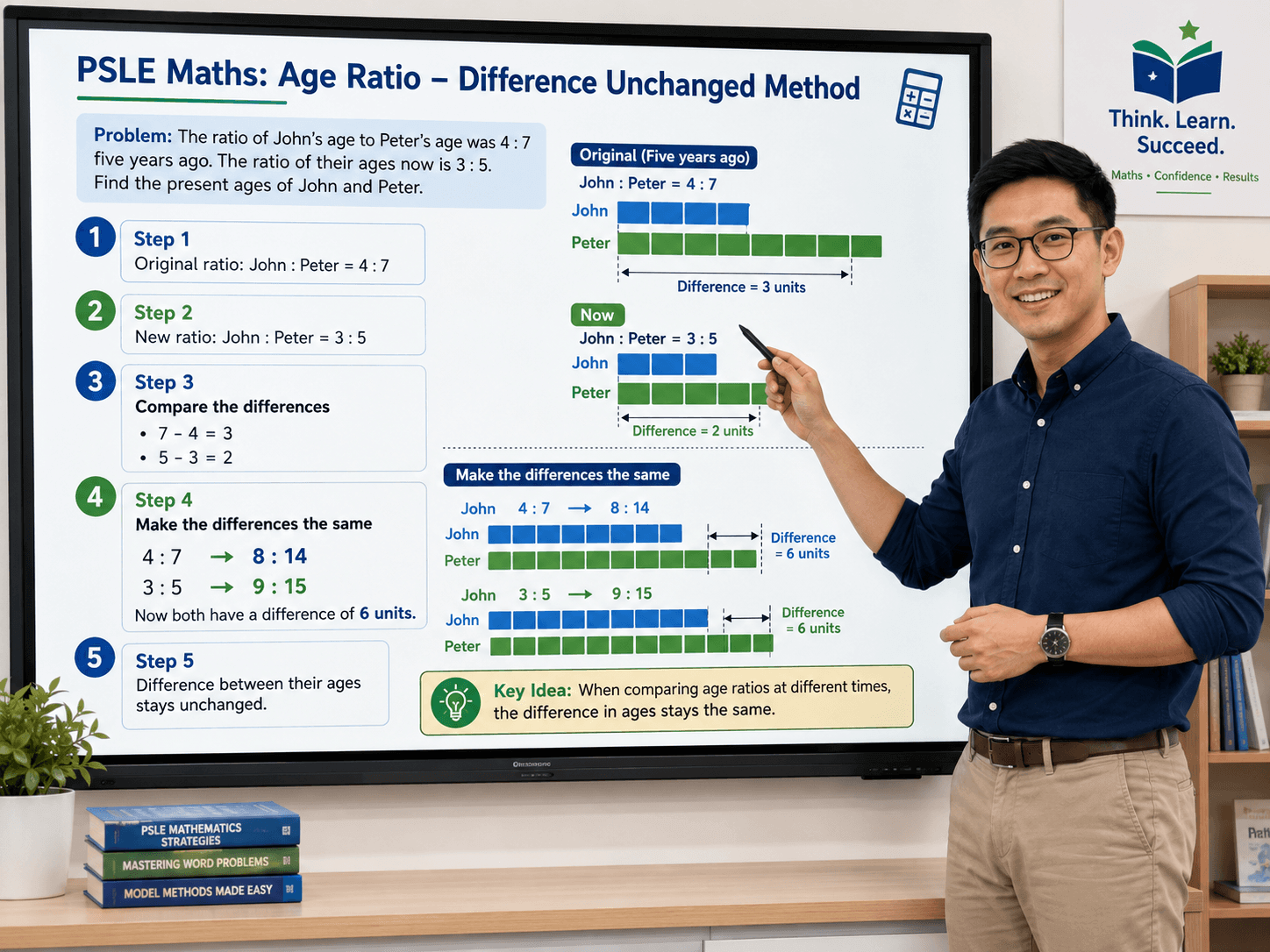
The Question / Scenario Explanation
Source: Ages in 4:7 ratio. In 4 years, 3:5. How old is Peter now?
The question states:
The ages of John and Peter are in the ratio:
\( 4:7 \)
In four years’ time, their ages will be in the ratio:
\( 3:5 \)
We need to find Peter’s present age.
The key fact is that both John and Peter increase in age by exactly four years. Therefore, the difference between their ages stays the same.
For example, if one person is 10 years older than another today, that person will still be 10 years older four years later.
This is why the difference unchanged strategy works so well for this type of PSLE age ratio problem.
Step-by-Step Solution / Explanation
Step 1: Write the Present Age Ratio
John : Peter
\( 4:7 \)
Find the difference between the ratio units:
\( 7 – 4 = 3 \)
So their present age difference is represented by 3 units.
Step 2: Write the Ratio 4 Years Later
Four years later:
John : Peter
\( 3:5 \)
Find the difference:
\( 5 – 3 = 2 \)
The age difference is now represented by 2 units.
However, the actual difference in their ages has not changed.
Step 3: Make the Ratio Differences Equal
The present ratio has a difference of \(3\) units, while the future ratio has a difference of \(2\) units.
Find a common value for both differences.
The lowest common multiple of \(3\) and \(2\) is \(6\).
Multiply the present ratio \(4:7\) by \(2\):
\( 4 \times 2 : 7 \times 2 \)
\( 8:14 \)
The difference is now:
\( 14 – 8 = 6 \)
Multiply the future ratio \(3:5\) by \(3\):
\( 3 \times 3 : 5 \times 3 \)
\( 9:15 \)
The difference is also:
\( 15 – 9 = 6 \)
Step 4: Compare the Present and Future Ratios
Present:
\( 8:14 \)
Four years later:
\( 9:15 \)
John increases from \(8\) units to \(9\) units.
Peter increases from \(14\) units to \(15\) units.
For each person, the increase is:
\( 1\text{ unit} \)
We know that this increase represents four years.
Therefore:
\( 1\text{ unit} = 4\text{ years} \)
Step 5: Find Peter’s Present Age
Peter’s current age is represented by \(14\) units.
Since:
\( 1\text{ unit} = 4\text{ years} \)
then:
\( 14 \times 4 = 56 \)
Final Answer: \( \boxed{\text{Peter is 56 years old.}} \)
Step 6: Check the Answer
If Peter is \(56\) years old, John’s present age is:
\( 8 \times 4 = 32 \)
Check the present ratio:
\( 32:56 \)
Divide both terms by \(8\):
\( 4:7 \)
Correct.
Four years later:
John:
\( 32 + 4 = 36 \)
Peter:
\( 56 + 4 = 60 \)
Check the new ratio:
\( 36:60 \)
Divide both terms by \(12\):
\( 3:5 \)
So the answer is confirmed.
Key Concepts Students Must Know
- Age difference remains unchanged: When the same number of years is added to both people, the difference between their ages stays the same.
- Ratio units can change: The same actual age difference may be represented by different numbers of units in different ratios.
- Equalise the differences: Before comparing the two ratios, make their difference in units the same.
- Compare corresponding people: Once the differences are equalised, compare John’s units before and after or Peter’s units before and after.
- The increase represents elapsed time: Here, an increase of \(1\) unit represents four years.
- Always verify the final answer: Substitute the ages back into both ratios.
Exam Tips / Common Mistakes
Exam Tips
- When you see an age ratio question, ask whether the difference in ages stays unchanged.
- Write the difference between the ratio units beside each ratio.
- Make those differences equal before comparing the two situations.
- Keep track of which ratio represents “now” and which represents “later”.
- Use the increase in units to find the value of one unit.
- At the end, substitute the ages back into both ratios to check your answer.
Common Mistakes
- Adding 4 directly to the ratio numbers: A ratio of \(4:7\) does not become \(8:11\) simply because four years have passed.
- Comparing unequal ratio differences: Students cannot directly compare \(4:7\) and \(3:5\) unit by unit because their unit sizes are different.
- Forgetting that the age difference is constant: This is the main clue in the question.
- Using 15 units for Peter’s current age: \(15\) units represents Peter four years later. His present age is represented by \(14\) units.
- Stopping at one unit equals four years: The question asks for Peter’s age, so students must calculate \(14 \times 4\).
Parent Insight
A PSLE age ratio question often tests whether students understand relationships rather than simply whether they can multiply and divide ratios.
The phrase parents can reinforce at home is “difference unchanged”. If two people both become four years older, their age gap does not change.
Instead of encouraging children to memorise a formula, ask them to explain why the age difference remains constant. Once that relationship is understood, equalising the ratio differences becomes much more logical.
This type of reasoning is also useful in other PSLE Maths ratio questions involving quantities whose difference stays unchanged over time.
Conclusion
To solve this PSLE age ratio problem, begin by identifying the unchanged age difference.
The present ratio \(4:7\) has a difference of \(3\) units, while the future ratio \(3:5\) has a difference of \(2\) units.
Equalise the differences:
\( 4:7 = 8:14 \)
and:
\( 3:5 = 9:15 \)
From \(14\) units to \(15\) units, Peter’s age increases by \(1\) unit over four years.
Therefore:
\( 1\text{ unit} = 4\text{ years} \)
Peter’s present age is:
\( 14 \times 4 = 56 \)
So Peter is 56 years old.
Visit our PSLE Maths homepage: Explore PSLEMathsTuition
Read more PSLE Maths guides: Visit Our PSLE Maths Blog
Start here (limited slots weekly):
Free Trial: Click Here…
Enroll: Click Here…
Explore our main tuition brand approach here: Click Here…