Introduction
Percentage mental maths becomes much easier when students learn to break a percentage into smaller, friendlier parts. Instead of reaching for a calculator straight away, many percentage questions can be solved quickly by finding \(1\%\) first.
In this example, Coach shows how to calculate \(7\%\) of 400 in just two simple steps. The same method can be used for many other percentage questions, especially when the percentage is not an obvious multiple of \(10\%\).
This is a useful PSLE Maths strategy because it strengthens number sense and helps students become more confident with percentages.
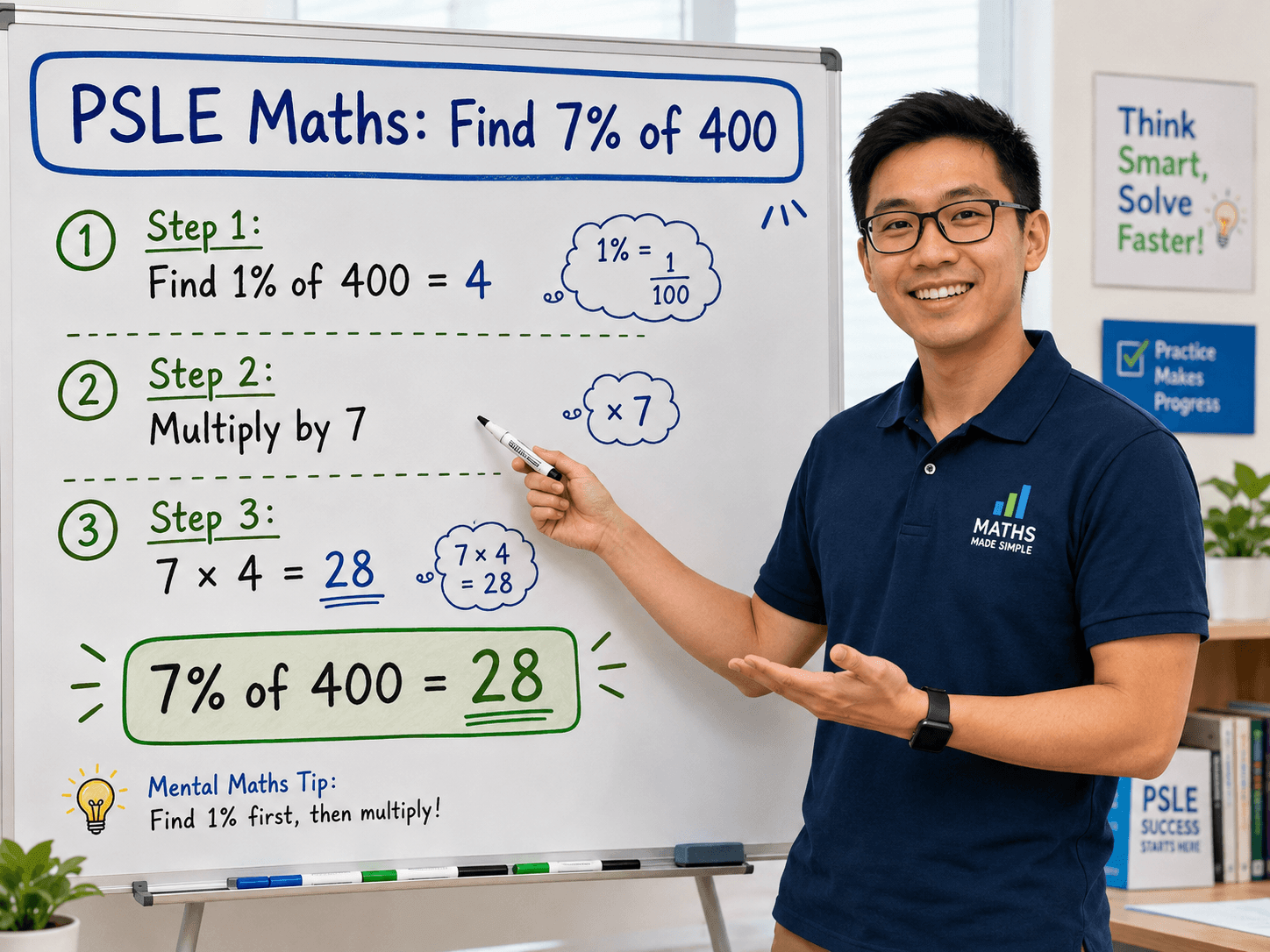
The Question / Scenario Explanation
Source: 7% of 400 without a calculator?
The question is:
\(7\%\text{ of }400\)
Some students may immediately convert \(7\%\) into a fraction or decimal and calculate:
7100400
That method is correct, but there is a faster mental approach.
First find \(1\%\) of 400. Then multiply that result by 7.
This works because:
\(7\% = 7 \times 1\%\)
Step-by-Step Solution / Explanation
Step 1: Find 1% of 400
To find \(1\%\) of a number, divide the number by 100.
\(1\%\text{ of }400 = 400 \div 100\)
=4
So:
\(1\%\text{ of }400 = 4\)
Step 2: Multiply by 7
Since we want \(7\%\), multiply the value of \(1\%\) by 7.
47=28
Therefore:
\(7\%\text{ of }400 = 28\)
Final Answer: \( \boxed{28} \)
Step 3: Check Using the Standard Percentage Method
We can confirm the answer using the usual percentage formula:
7100400
Cancel 400100:
74=28
The answer is the same.
Step 4: Try the Challenge — 3% of 900
Now apply the same method to:
\(3\%\text{ of }900\)
First find \(1\%\):
900100=9
So:
\(1\%\text{ of }900 = 9\)
Then multiply by 3:
93=27
Therefore:
\(3\%\text{ of }900 = 27\)
Step 5: Why Finding 1% First Works
A percentage tells us how many parts out of 100.
For example:
\(1\% = \frac{1}{100}\)
Therefore, finding \(1\%\) simply means dividing by 100.
Once students know the value of \(1\%\), they can build many other percentages from it.
For example:
\(6\% = 6 \times 1\%\)
\(8\% = 8 \times 1\%\)
\(13\% = 13 \times 1\%\)
This makes percentage mental maths much more flexible.
Key Concepts Students Must Know
- Percent means out of 100: \(1\% = \frac{1}{100}\).
- Find 1% by dividing by 100: This gives a useful base value for many percentage questions.
- Build the required percentage: Multiply the value of \(1\%\) by the required percentage number.
- Mental Maths is about decomposition: Breaking a difficult-looking calculation into easier parts reduces errors.
- Always check reasonableness: Since \(10\%\) of 400 is 40, \(7\%\) should be less than 40. An answer of 28 makes sense.
Exam Tips / Common Mistakes
Exam Tips
- When a percentage looks awkward, try finding \(1\%\) first.
- Remember that finding \(1\%\) means dividing by 100, not by 10.
- Use known benchmarks such as \(10\%\), \(5\%\) and \(1\%\) to check your answer.
- If the final percentage is less than \(10\%\), the answer should normally be less than \(10\%\) of the original number.
- Write down short working in exams even if you can do the calculation mentally.
Common Mistakes
- Finding 10% instead of 1%: \(10\%\) of 400 is 40, while \(1\%\) is 4.
- Dividing by the percentage: Students may incorrectly calculate 4007.
- Forgetting to multiply back: Finding \(1\%\) is only the first step. Students must still multiply by 7.
- Misplacing zeros: Dividing 400 by 100 gives 4, not 40.
- Using a calculator unnecessarily: Simple mental strategies can save time and help students check calculator answers.
Parent Insight
Percentage questions often become difficult when students see the percentage symbol and immediately think they need a complicated formula.
A useful way to build confidence is to start with the meaning of \(1\%\). Once children understand that \(1\%\) means one out of every hundred, many calculations become much easier.
Parents can practise quick questions such as:
- What is \(1\%\) of 500?
- What is \(6\%\) of 500?
- What is \(1\%\) of 800?
- What is \(9\%\) of 800?
This helps children see percentage calculations as patterns rather than isolated formulas.
Conclusion
To solve \(7\%\) of 400 using percentage mental maths, first find \(1\%\):
400100=4
Then multiply by 7:
47=28
So:
\(7\%\text{ of }400 = 28\)
The key technique is simple: when the percentage looks awkward, find 1% first.
Visit our PSLE Maths homepage: Explore PSLEMathsTuition
Read more PSLE Maths guides: Visit Our PSLE Maths Blog
Start here (limited slots weekly):
Free Trial: Click Here…
Enroll: Click Here…
Explore our main tuition brand approach here: Click Here…