Introduction
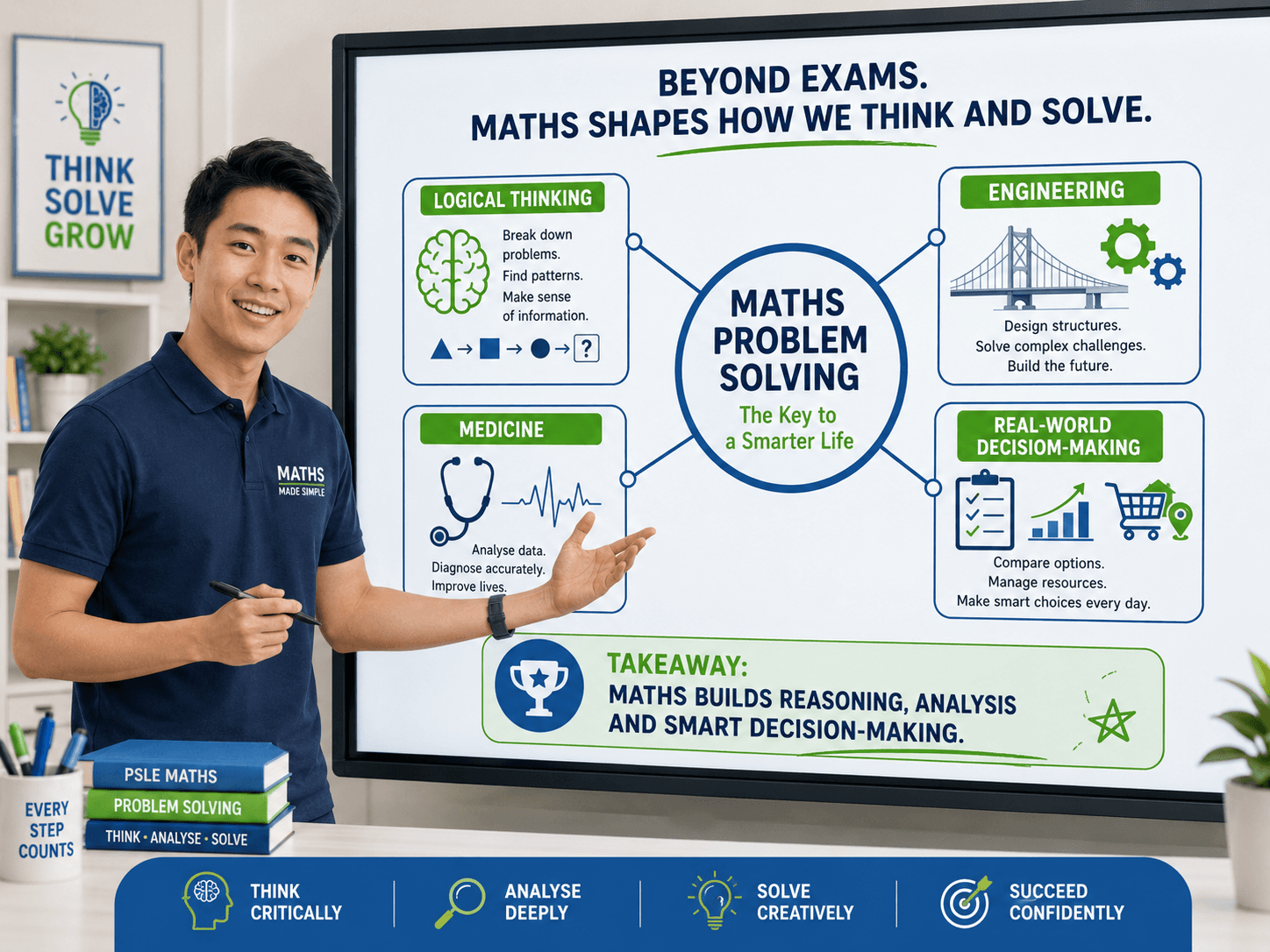
Math problem solving is not only about getting the correct answer in an exam. It also teaches students how to break complex situations into smaller parts, think logically, test different approaches and adjust when something does not work.
In this video, Coach Xi shares how studying engineering helped prepare him for medical school and why he still teaches Maths alongside his medical training. His experience shows how the thinking habits developed through Mathematics can carry over into completely different fields.
For PSLE Maths students, this is an important reminder: every challenging question is also an opportunity to practise how to think, not just how to score.
The Question / Scenario Explanation
Source: Engineering, med school, still teaching maths on the side.
Coach Xi studied engineering before continuing into medical training. At first glance, engineering, medicine and teaching Maths may appear to be three very different areas.
However, they share an important foundation: structured problem solving.
Engineering often involves taking a large problem and breaking it into smaller, manageable steps. Medicine also requires careful reasoning: observe information, analyse possible causes, test an idea and adjust based on the result.
This is very similar to what students do in Maths.
A difficult PSLE problem may initially feel unfamiliar. But once students learn to identify the information given, determine what they need to find and choose an appropriate strategy, the question becomes much more manageable.
Step-by-Step Solution / Explanation
Step 1: Break a Big Problem Into Smaller Parts
One of the most useful skills students learn through math problem solving is decomposition.
Instead of trying to solve an entire question immediately, students can ask:
- What information has been given?
- What am I trying to find?
- Which information is important?
- What can I calculate first?
For example, suppose a PSLE Maths question gives the total cost of several items and asks for the price of one item.
A student may first find the value of the known items, subtract that amount from the total, and only then determine the unknown price.
The problem becomes easier because it has been divided into smaller steps.
Step 2: Think Logically About Cause and Effect
Maths encourages students to ask, “If this is true, what follows?”
For example:
If:
\( 5 \times \square = 40 \)
then the missing number must satisfy:
\( \square = 40 \div 5 \)
\( \square = 8 \)
This may look simple, but the underlying skill is logical reasoning.
Students are learning to connect one piece of information to another and make a justified conclusion.
Step 3: Test Whether the Answer Makes Sense
Good problem solving does not end when a calculation is complete.
Students should also check:
Does my answer make sense?
If a question asks for the number of students in a class and the answer is 3.7, something is wrong because the context requires a whole number.
If a length is calculated as negative, students should revisit their working.
This habit of checking a result is useful in Maths, science, engineering and many real-world situations.
Step 4: Learn From Failed Attempts
Students sometimes assume that getting a question wrong means they are “bad at Maths”. In reality, analysing an incorrect attempt can be one of the most valuable parts of learning.
A useful process is:
- Attempt the question.
- Check the answer.
- Identify where the working went wrong.
- Correct the method.
- Try a similar question again.
This cycle builds both mathematical understanding and resilience.
Step 5: Apply the Same Thinking to Unfamiliar Questions
PSLE questions do not always look exactly like the examples students have practised.
This is why memorising procedures alone is not enough.
Students need to recognise the underlying concept and decide which strategy fits the new question.
For example, a ratio problem may be presented using money, ages, marbles or distances. The story changes, but the mathematical relationship may be very similar.
Strong students learn to see the structure behind the context.
Step 6: Understand Why Maths Matters Beyond School
The same reasoning habits appear in many areas beyond the classroom.
An engineer may ask:
“What is causing this system to fail, and which part should we test first?”
A doctor may ask:
“Given these symptoms and test results, what explanations are possible?”
A programmer may ask:
“If this condition happens, what should the program do next?”
These are not identical to PSLE Maths questions, but they rely on similar habits: analyse information, identify relationships, test possibilities and reach a logical conclusion.
Key Concepts Students Must Know
- Problem decomposition: Break complicated questions into smaller, manageable steps.
- Logical reasoning: Use the information given to justify each next step.
- Pattern recognition: Identify familiar mathematical relationships even when the question looks different.
- Checking: Decide whether the final result is reasonable and fits the context.
- Adjustment: When a strategy does not work, identify why and try another approach.
- Transfer of learning: Skills developed in Maths can support thinking in science, technology and everyday decision-making.
These are some of the reasons why math problem solving remains valuable even when students are not directly using a formula or calculation.
Exam Tips / Common Mistakes
Exam Tips
- Read the entire question before beginning your calculation.
- Underline or identify what the question is actually asking for.
- Separate useful information from distracting details.
- Break multi-step questions into smaller calculations.
- Draw a model, table or diagram when it helps make the relationship clearer.
- Check whether your answer is reasonable before moving on.
- If you are stuck, ask yourself what information you can find first instead of trying to solve everything at once.
Common Mistakes
- Jumping straight into calculations: Students may start manipulating numbers before understanding the question.
- Trying to memorise every question type: Exam questions can change their context, so understanding the underlying concept is more reliable.
- Giving up after one unsuccessful method: A wrong approach can still reveal useful information about the problem.
- Ignoring the final answer: Students should always check whether the result is sensible.
- Focusing only on speed: Fast working is useful only when the reasoning remains accurate.
Parent Insight
It is common for children to ask, “When will I ever use this Maths?” The answer is not always that they will use the exact same equation or model diagram later in life.
The bigger value often lies in the thinking process.
When children work through a challenging Maths problem, they practise staying with a problem, organising information, testing a method and correcting themselves when necessary.
Parents can reinforce these habits by asking questions such as:
- “What do you know so far?”
- “What are you trying to find?”
- “Can you break the question into smaller parts?”
- “Does your answer make sense?”
- “What could you try differently?”
These prompts encourage children to become more independent thinkers instead of waiting immediately for a solution.
Conclusion
Math problem solving goes beyond earning a mark on a worksheet or examination paper.
It develops habits such as breaking problems into smaller parts, thinking logically, checking results, learning from mistakes and adapting when an approach does not work.
Coach Xi’s journey from engineering into medicine is one example of how these habits can continue to be useful across very different fields.
For PSLE students, the immediate goal may be to become stronger and more confident in Maths. But the longer-term benefit is learning how to approach difficult problems with structure, patience and clear reasoning.
Visit our PSLE Maths homepage: Explore PSLEMathsTuition
Read more PSLE Maths guides: Visit Our PSLE Maths Blog
Start here (limited slots weekly):
Free Trial: Click Here…
Enrol: Click Here…
Explore our main tuition brand approach here: Click Here…