Introduction
Many students find it frustrating to subtract from 1000 when the number has zeros in the minuend. Traditional borrowing across zeros can feel slow, messy and easy to get wrong.
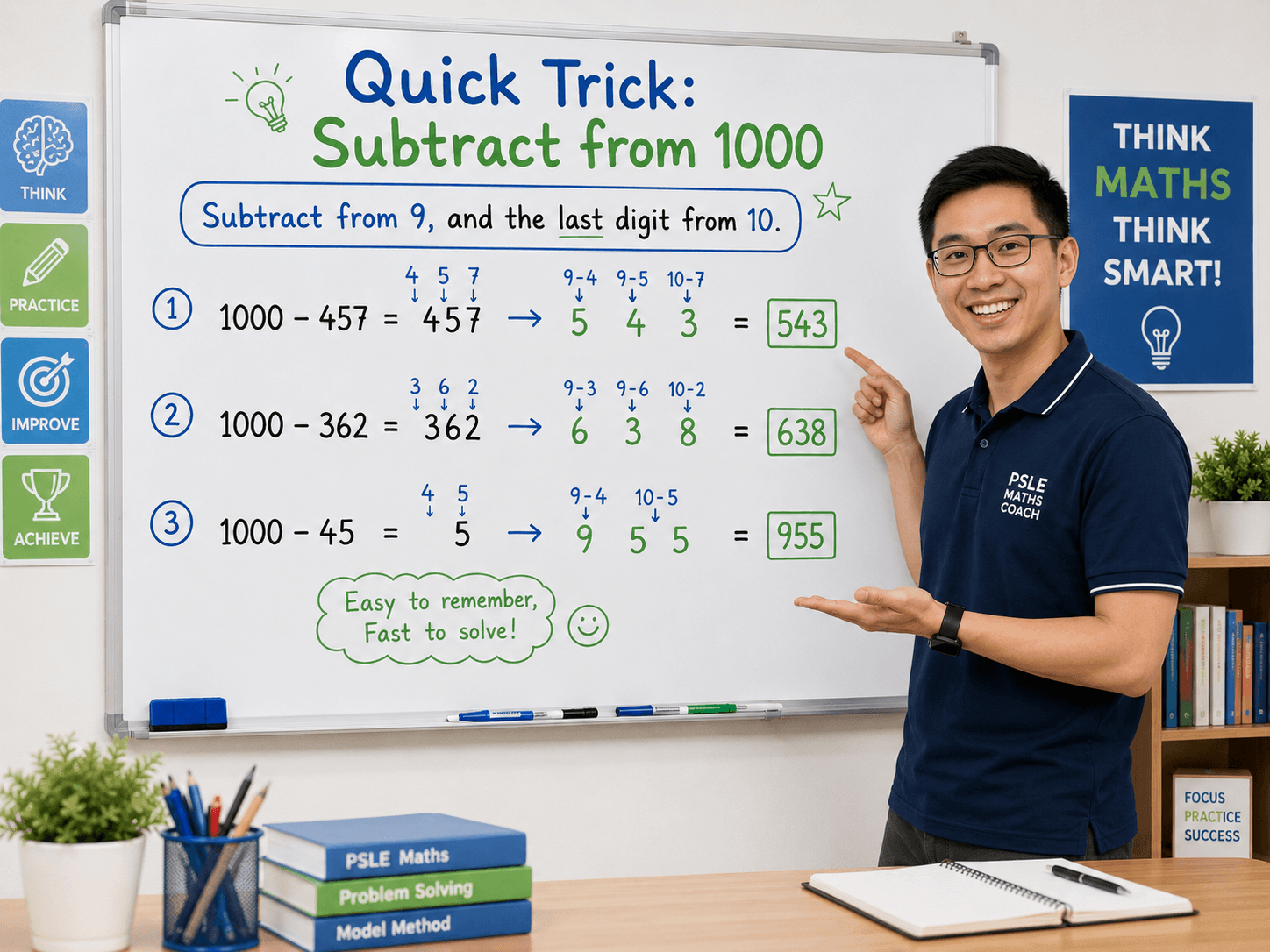
In this lesson, Coach Mustafa shares a fast mental method that helps students subtract from 1000 without repeatedly crossing out digits. It works especially well for three-digit numbers and can even be adapted for shorter numbers such as \(45\), by writing it as \(045\).
This is a useful PSLE Maths shortcut because it builds confidence in mental arithmetic while helping students spot patterns in subtraction.
The Question / Scenario Explanation
Source: Still borrowing across zeros to subtract from 1000? Stop. Coach Mustafa shows a 3-second trick.
The trick is designed for subtraction questions of the form:
\( 1000 – \text{three-digit number} \)
Instead of doing the full borrowing method, students can use this quick rule:
- Subtract the first digit from \(9\).
- Subtract the middle digit from \(9\).
- Subtract the last digit from \(10\).
For example, to calculate \(1000 – 457\):
\( 9 – 4 = 5 \)
\( 9 – 5 = 4 \)
\( 10 – 7 = 3 \)
So the answer is:
\( 543 \)
This method can also be used for \(1000 – 45\) by treating \(45\) as \(045\).
Step-by-Step Solution / Explanation
Step 1: Understand the Pattern
When students subtract from 1000, the quick method works because:
- the first two digits are subtracted from \(9\), and
- the last digit is subtracted from \(10\).
This matches what happens when borrowing across the zeros, but the trick lets students get the answer faster.
Step 2: Example 1 — \(1000 – 457\)
Break \(457\) into its digits: \(4\), \(5\), and \(7\).
Now apply the rule:
\( 9 – 4 = 5 \)
\( 9 – 5 = 4 \)
\( 10 – 7 = 3 \)
So:
\( 1000 – 457 = 543 \)
Step 3: Example 2 — \(1000 – 362\)
Break \(362\) into digits: \(3\), \(6\), and \(2\).
Apply the same rule:
\( 9 – 3 = 6 \)
\( 9 – 6 = 3 \)
\( 10 – 2 = 8 \)
So:
\( 1000 – 362 = 638 \)
Step 4: Example 3 — \(1000 – 45\)
Since \(45\) has only two digits, rewrite it as \(045\).
Now apply the trick:
\( 9 – 0 = 9 \)
\( 9 – 4 = 5 \)
\( 10 – 5 = 5 \)
So:
\( 1000 – 45 = 955 \)
Step 5: Try the Challenge — \(1000 – 756\)
Break \(756\) into digits: \(7\), \(5\), and \(6\).
Now calculate:
\( 9 – 7 = 2 \)
\( 9 – 5 = 4 \)
\( 10 – 6 = 4 \)
So:
\( 1000 – 756 = 244 \)
Final Answer: \( \boxed{244} \)
Step 6: Why the Trick Works
This shortcut is based on complements to \(1000\).
For instance:
\( 1000 – 457 = 543 \)
because:
\( 457 + 543 = 1000 \)
The first digits use complements to \(9\), while the final digit uses the complement to \(10\). That is why the last step is slightly different.
Key Concepts Students Must Know
- Place value matters: Every digit must stay in its correct hundreds, tens and ones place.
- Subtracting from 1000 follows a pattern: first digits from \(9\), last digit from \(10\).
- Shorter numbers can be padded with zeros: For example, \(45\) becomes \(045\).
- The answer is a complement to 1000: The original number and the answer should add up to \(1000\).
- Mental Maths can be systematic: Fast calculation is not guessing. It follows a clear rule.
This shortcut is a good example of how understanding patterns can make PSLE Maths more manageable.
Exam Tips / Common Mistakes
Exam Tips
- Always line up the digits correctly before starting.
- If the number has fewer than three digits, add zeros in front first.
- Remember the final digit is subtracted from \(10\), not \(9\).
- After using the trick, check by adding your answer back to the original number.
- Use this method for speed, but make sure you still understand the usual subtraction method too.
Common Mistakes
- Subtracting every digit from \(9\): The last digit must be subtracted from \(10\).
- Forgetting to pad with zeros: \(45\) should be treated as \(045\), not just two digits.
- Mixing up the order of digits: Write the digits in the correct places before applying the trick.
- Using the trick without checking: Students should confirm the answer by addition if unsure.
- Depending only on shortcuts: Exam confidence improves most when students know both the concept and the shortcut.
Parent Insight
Parents often notice that children get stuck when subtracting numbers like \(1000 – 457\) because the usual borrowing process across zeros feels intimidating.
Shortcuts like this can reduce stress and make Maths feel more approachable. More importantly, they show students that number patterns can make calculations easier.
That said, it is still important for children to understand standard subtraction properly. A shortcut should support understanding, not replace it. When students know both methods, they become more flexible and confident problem solvers.
Conclusion
To subtract from 1000 quickly, students can use a simple pattern: subtract the first digits from \(9\) and the last digit from \(10\).
This turns questions like \(1000 – 457\), \(1000 – 362\), and \(1000 – 045\) into fast mental calculations without messy borrowing across zeros.
With regular practice, this trick can save time and improve confidence in PSLE Maths mental arithmetic.
Visit our homepage: Click Here…
Read more on our blog: Click Here…
Start here (limited slots weekly):
Free Trial: Click Here…
Enroll: Click Here…
Explore our main tuition brand approach here: Click Here…