Introduction
A semicircle radius question can look confusing when several identical semicircles overlap along one straight line. The key is not to focus on every curve at once, but to compare the total horizontal lengths carefully.
In this example, Coach Mo uses a simple visual idea involving Harry Potter travelling across the top and Spider-Man travelling across the bottom. This helps students see two different paths made up of the same semicircle diameters.
Once the two horizontal models are compared, the unknown diameter can be found quickly, and from there the radius is simply half of that diameter.
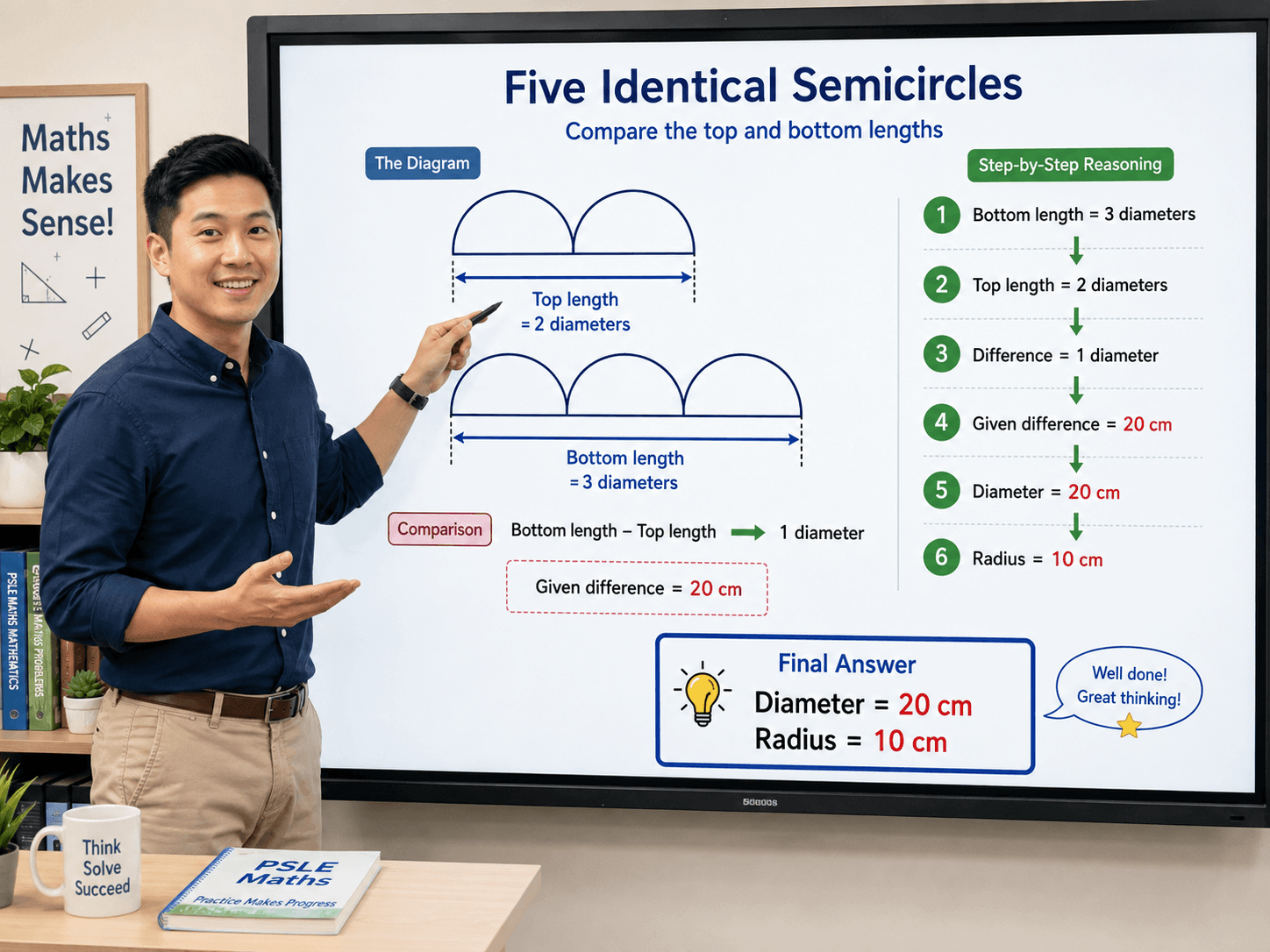
The Question / Scenario Explanation
Source: Coach Mo solves for the radius using 5 identical semicircles.
The question shows five identical semicircles arranged along the same horizontal line. Some gaps are labelled \(15\text{ cm}\), \(12\text{ cm}\), and \(11\text{ cm}\).
The task is to find the radius of one semicircle.
Because all five semicircles are identical, every diameter has the same length. Let the diameter be \(d\).
Coach Mo compares two different ways of travelling across the same total span.
Top path:
\(15 + d + 12 + d + 15\)
This gives:
\(2d + 42\)
Bottom path:
\(d + 11 + d + 11 + d\)
This gives:
\(3d + 22\)
Since both paths cover the same total horizontal length, they must be equal.
Step-by-Step Solution / Explanation
Step 1: Represent Each Semicircle by Its Diameter
Since all five semicircles are identical, their diameters are equal.
Let one diameter be:
\(d\)
This makes the diagram easier to compare because every semicircle contributes the same horizontal length.
Step 2: Find the Total Length Along the Top
Looking along the top, the total length is made up of:
\(15\text{ cm} + d + 12\text{ cm} + d + 15\text{ cm}\)
Combine the known lengths:
\(15 + 12 + 15 = 42\)
So the top path is:
\(2d + 42\)
Step 3: Find the Total Length Along the Bottom
Looking along the bottom, the total length is:
\(d + 11\text{ cm} + d + 11\text{ cm} + d\)
Combine the known lengths:
\(11 + 11 = 22\)
So the bottom path is:
\(3d + 22\)
Step 4: Compare the Two Equal Total Lengths
Both expressions describe the same overall horizontal distance, so:
\(2d + 42 = 3d + 22\)
Subtract \(2d\) from both sides:
\(42 = d + 22\)
Subtract \(22\) from both sides:
\(d = 20\)
So the diameter of one semicircle is:
\(20\text{ cm}\)
Step 5: Find the Radius
The radius is half the diameter.
\(r = \frac{20}{2}\)
\(r = 10\)
Final Answer: \( \boxed{10\text{ cm}} \)
Key Concepts Students Must Know
- Identical semicircles have equal diameters: Every semicircle contributes the same length across its flat side.
- Diameter is twice the radius: \(d = 2r\).
- Radius is half the diameter: \(r = \frac{d}{2}\).
- Compare equal total lengths: Two different expressions representing the same horizontal span can be set equal.
- Model the diagram: Replacing repeated shapes with the same variable makes the structure easier to see.
Exam Tips / Common Mistakes
Exam Tips
- Look for repeated identical shapes before starting any calculations.
- Label the unknown diameter with a simple variable such as \(d\).
- Separate the top path and bottom path clearly.
- Add the known lengths first to reduce clutter.
- Remember to divide by \(2\) at the end because the question asks for the radius, not the diameter.
- Check whether both model expressions represent the same total horizontal length before setting them equal.
Common Mistakes
- Finding 20 cm and stopping: \(20\text{ cm}\) is the diameter, not the radius.
- Counting the wrong number of diameters: The top model has two diameters, while the bottom model has three.
- Adding the 11 cm lengths incorrectly: \(11 + 11 = 22\), not 11.
- Ignoring that all semicircles are identical: The repeated diameter length is the main clue that makes the problem solvable.
- Trying to use area or circumference formulas: They are not needed because this question is about horizontal lengths only.
Parent Insight
This type of PSLE Maths question is a good example of why visual modelling is so important. The diagram may look complicated because several semicircles overlap, but the actual mathematics is based on comparing equal lengths.
Parents can help by encouraging children to redraw complex diagrams in simpler forms. Ask them, “Which parts are repeated?” and “Can we replace them with the same symbol?”
Once students learn to reduce a busy diagram into a simple model, they are much less likely to feel overwhelmed by unfamiliar geometry questions.
Conclusion
To find the semicircle radius, first represent every identical diameter by \(d\).
The top path gives \(2d + 42\), while the bottom path gives \(3d + 22\). Since both represent the same total horizontal length:
\(2d + 42 = 3d + 22\)
This gives \(d = 20\text{ cm}\). Since the radius is half the diameter:
\(r = 10\text{ cm}\)
The main exam skill is recognising that a complicated-looking diagram can often be simplified into two clear comparison models.
Visit our PSLE Maths homepage: Explore PSLEMathsTuition
Read more PSLE Maths guides: Visit Our PSLE Maths Blog
Start here (limited slots weekly):
Free Trial: Click Here…
Enroll: Click Here…
Explore our main tuition brand approach here: Click Here…