Introduction
Have you ever wondered about the history of algebra and where the word “algebra” actually came from? One of the most important names in that story is the ninth-century mathematician Muhammad ibn Musa al-Khwarizmi.
Al-Khwarizmi did not single-handedly invent all of algebra—mathematical methods for solving unknown quantities existed centuries earlier. However, his work helped organise algebra into a systematic subject with general methods for solving different types of equations.
His influence was so significant that both the words algebra and algorithm are connected to his work and name. For students learning Maths today, his story is a fascinating reminder that the methods used in modern classrooms have roots stretching back more than a thousand years.
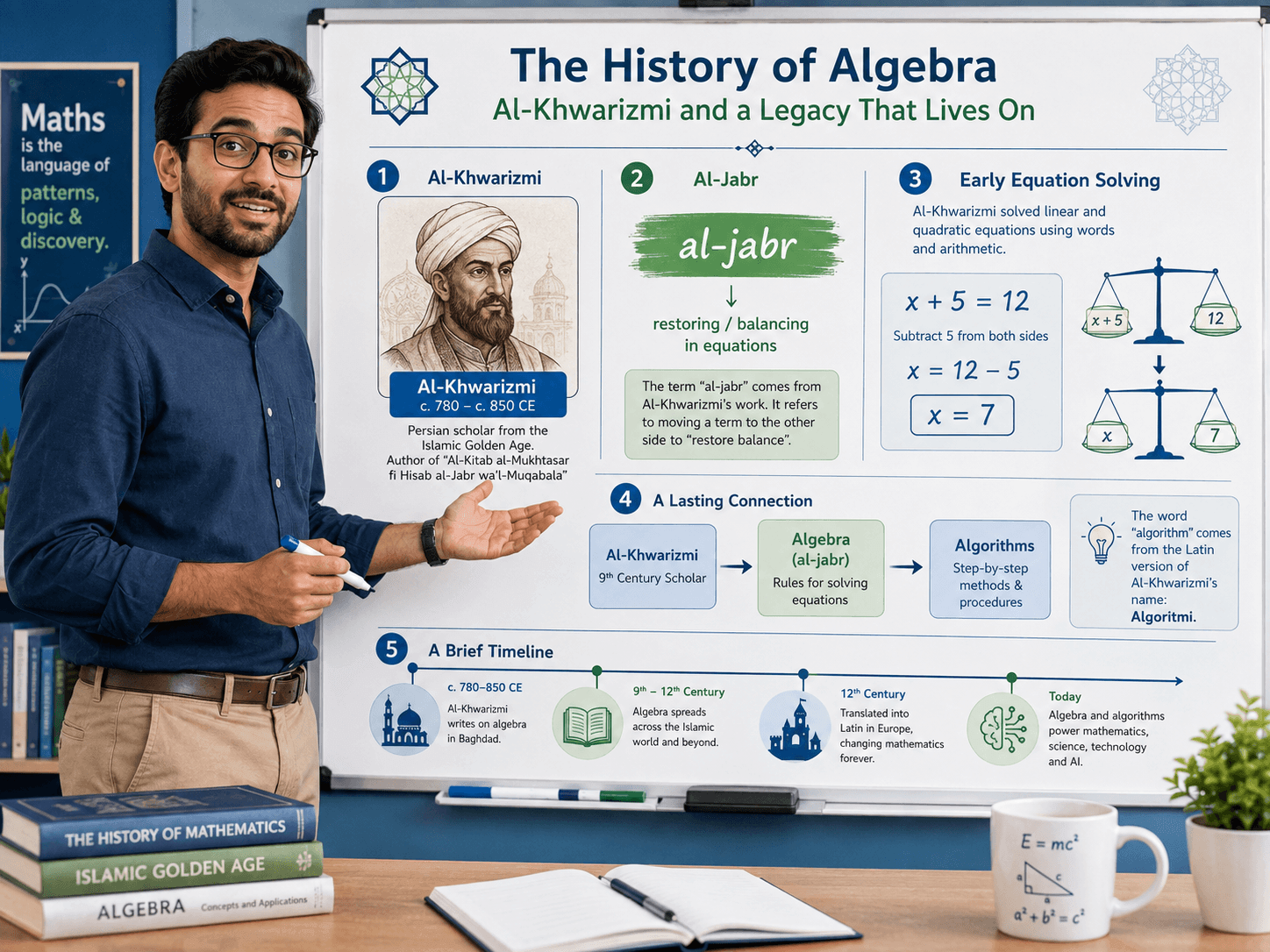
The Question / Scenario Explanation
Source: Who invented algebra? The answer may surprise you!
The video introduces Al-Khwarizmi, a scholar who worked in Baghdad during the ninth century and wrote an influential mathematical text commonly known by its shortened Arabic title involving al-jabr and al-muqabala.
The term al-jabr eventually contributed to the English word “algebra”. Al-Khwarizmi’s name was also transformed in Medieval Latin, helping give rise to the word “algorithm”.
However, there is an important historical detail students should understand: Al-Khwarizmi did not create mathematics involving unknown quantities from nothing.
Earlier Babylonian, Greek and Indian mathematicians had already developed methods for solving mathematical problems that we would now describe as algebraic. Al-Khwarizmi’s major contribution was helping present equation-solving as a more organised and systematic mathematical discipline.
Another useful correction is that the algebra in his book was mostly written using words rather than the modern symbols \(x\), \(y\) and \(=\) that students recognise today. Those notations developed much later.
Step-by-Step Solution / Explanation
Step 1: Mathematics with Unknown Values Existed Before Al-Khwarizmi
The history of algebra began long before the ninth century.
Ancient mathematicians already solved problems involving unknown quantities. For example, a problem might essentially ask:
“A number plus 7 gives 15. What is the number?”
Today, we might write:
\( x + 7 = 15 \)
and solve:
\( x = 15 – 7 \)
\( x = 8 \)
Ancient mathematicians often expressed similar problems using words instead of our modern algebraic notation.
Step 2: Al-Khwarizmi Helped Make Equation Solving Systematic
During the ninth century, Al-Khwarizmi wrote an important mathematical work explaining systematic methods for solving equations.
Rather than treating every mathematical problem as completely separate, his approach grouped equations into recognisable types and explained methods that could be applied repeatedly.
This idea is extremely important in mathematics.
Students do something similar today. Instead of memorising an answer to one question, they learn a method that can solve many questions of the same type.
For example:
\( x + 5 = 12 \)
\( x + 9 = 20 \)
\( x + 13 = 30 \)
Although the numbers change, the same principle applies: subtract the added quantity from both sides.
Step 3: Where Did the Word “Algebra” Come From?
One important word in the title of Al-Khwarizmi’s mathematical work was al-jabr.
Over time, this word developed into the term algebra used today.
This is why Al-Khwarizmi is frequently described as one of the most important figures—or even the “father of algebra”—in the development of the subject.
The description is useful as long as students remember that algebra itself developed through contributions from several mathematical cultures over many centuries.
Step 4: Where Did the Word “Algorithm” Come From?
Al-Khwarizmi influenced another word that students hear frequently today: algorithm.
His name was rendered in Latin in forms such as “Algoritmi”. Over time, this contributed to the modern word “algorithm”.
An algorithm is essentially a clear sequence of steps for completing a task or solving a problem.
For example, consider:
\( 3x + 4 = 19 \)
A simple solving algorithm might be:
- Subtract \(4\) from both sides.
- Obtain \(3x = 15\).
- Divide both sides by \(3\).
- Obtain \(x = 5\).
That step-by-step thinking is closely connected to how students solve mathematics questions today.
Step 5: Why Does This Matter to Primary Maths Students?
Primary students may not yet study formal algebra in the same depth as Secondary students, but they already encounter many ideas that prepare them for it.
Consider:
\( \square + 18 = 45 \)
The box represents an unknown number. Students calculate:
\( 45 – 18 = 27 \)
so:
\( \square = 27 \)
Later, the same idea may be written as:
\( x + 18 = 45 \)
\( x = 27 \)
The notation changes, but the underlying reasoning is very similar.
Step 6: From Algebra to Modern Technology
Algebra and algorithms now appear throughout science, engineering, computing, finance and technology.
Computer programs use algorithms to process information and perform tasks. Mathematical equations are used to model everything from movement and electricity to business decisions and scientific experiments.
However, it is more accurate to say that modern technology grew from centuries of mathematical development rather than attributing its entire foundation to one person.
Al-Khwarizmi remains an especially important figure because his work helped establish systematic mathematical thinking that influenced generations of mathematicians after him.
Key Concepts Students Must Know
- Algebra existed in earlier forms before Al-Khwarizmi: Ancient civilisations were already solving problems involving unknown quantities.
- Al-Khwarizmi systematised algebra: His work presented general methods for solving different classes of equations.
- The word “algebra” is linked to “al-jabr”: A term appearing in the title of his influential mathematical work.
- The word “algorithm” is connected to Al-Khwarizmi’s name: His Latinised name influenced the development of the modern term.
- Modern algebraic symbols appeared later: Al-Khwarizmi did not write equations using \(x\), \(y\) and the modern equals sign in the way students do today.
- Primary Maths develops pre-algebra skills: Unknown-number questions, patterns and inverse operations prepare students for formal algebra later.
Exam Tips / Common Mistakes
Exam Tips
- When you see an unknown number, think about which operation will undo the operation already shown.
- Use inverse operations carefully: addition is undone by subtraction, while multiplication is undone by division.
- Write your working step by step instead of trying to calculate everything mentally.
- Check your answer by substituting it back into the original statement.
- Look for methods that work across many questions rather than memorising one specific answer.
Common Mistakes
- Saying Al-Khwarizmi invented all of algebra: He was enormously influential, but algebraic thinking existed before him.
- Assuming he invented \(x\) and \(y\): Modern symbolic algebra notation developed centuries later.
- Confusing algebra with arithmetic: Arithmetic mainly works with known numbers, while algebra allows students to reason about unknown quantities and general relationships.
- Changing operations incorrectly: Students should understand why inverse operations work rather than simply “moving” numbers across an equals sign.
- Ignoring the meaning of the equals sign: Both sides of an equation represent equal values and must remain balanced.
Parent Insight
When children ask, “Why do I need to learn algebra?”, the history of algebra offers a useful way to make the subject more meaningful.
Algebra is not simply a collection of letters and equations. It teaches children to represent unknown information, recognise relationships and follow logical steps to find a solution.
Even at Primary level, students develop these foundations whenever they solve missing-number questions, identify patterns, use models or work backwards from information given in a problem sum.
Parents can reinforce this thinking by asking questions such as, “What do we know?”, “What are we trying to find?” and “Which operation can help us work backwards?” These habits prepare students for more formal algebra in Secondary school.
Conclusion
The history of algebra is more interesting than simply asking who “invented” it. Mathematical ideas involving unknown quantities existed long before Al-Khwarizmi, but his ninth-century work played a major role in organising algebra into systematic methods for solving equations.
The word “algebra” is linked to al-jabr, while the word “algorithm” is connected to the Latinised form of Al-Khwarizmi’s name.
More than a thousand years later, students still practise the same broader mathematical habit his work helped advance: understand the problem, follow a logical method and use that method to solve many different questions.
Visit our PSLE Maths homepage: Explore PSLEMathsTuition
Read more Maths guides and learning tips: Visit Our PSLE Maths Blog
Start here (limited slots weekly):
Free Trial: Click Here…
Enroll: Click Here…
Explore our main tuition brand approach here: Click Here…