Introduction
Knowing how to check Maths answers effectively can be just as important as knowing how to solve the question. Students may understand the concept and use the correct method, yet still lose marks because of a careless calculation, copied number or unreasonable final answer.
In this lesson, Coach Ismath shares a simple habit students can use after completing a question: take about five seconds and ask, “Does my answer make sense?”
This quick reasonableness check does not replace proper working or revision. Instead, it gives students one final opportunity to catch an obvious mistake before moving on.
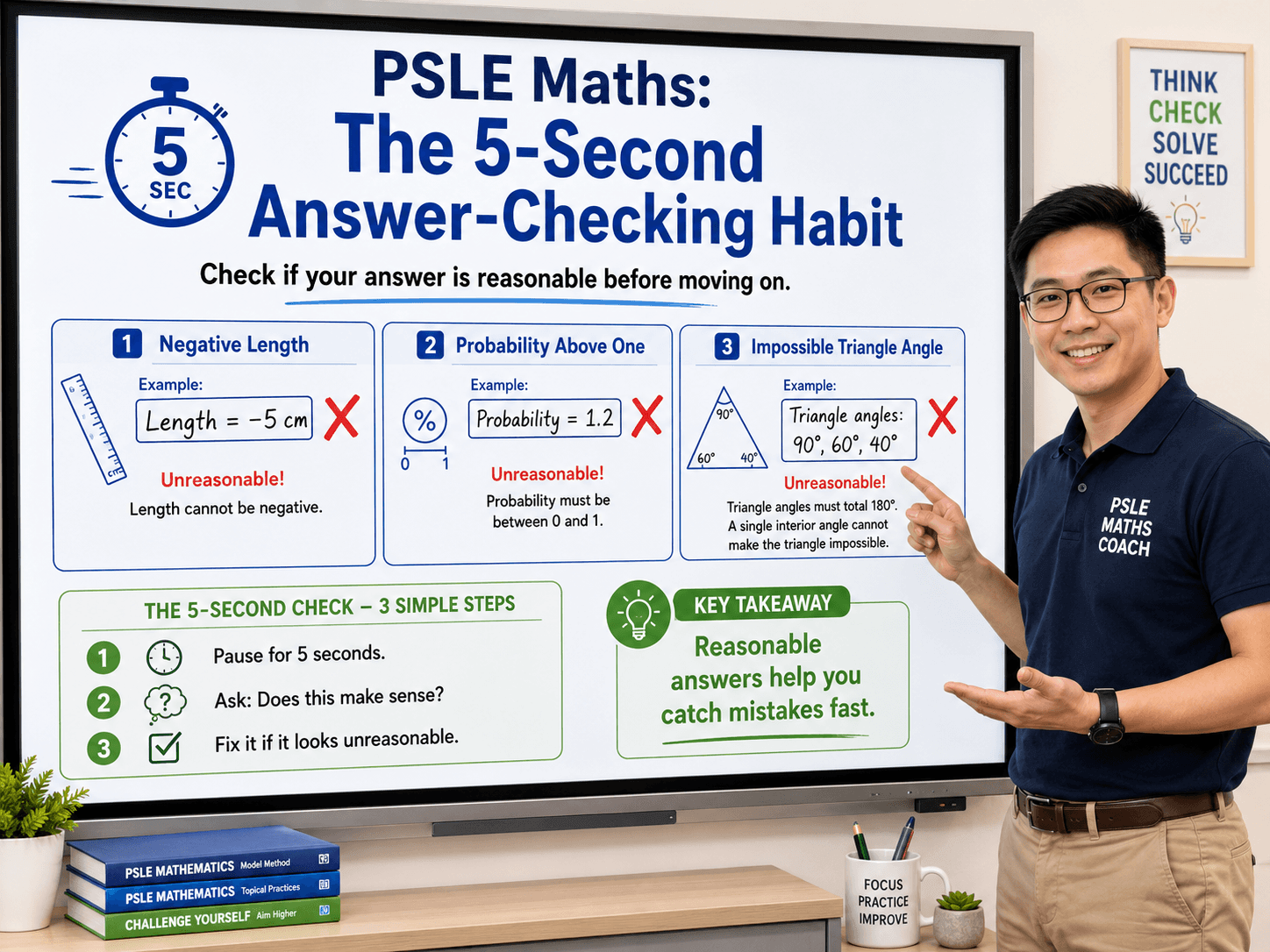
The Question / Scenario Explanation
Source: Not talent. Not hours. The one habit that separates A1 scorers.
Coach Ismath highlights a common pattern: two students may attend the same lessons, receive the same notes and understand the same concepts, but their final marks can still differ because of avoidable mistakes.
The key habit discussed in the video is not simply rereading every line of working. It is checking whether the final answer itself is reasonable.
For example, imagine obtaining:
- a negative length;
- a probability greater than \(1\);
- an angle greater than \(180^\circ\) inside a triangle; or
- a quantity that is obviously much larger or smaller than the information given.
These results should immediately signal that something may have gone wrong.
The habit is simple:
Finish the question → look at the answer → ask whether it is mathematically and contextually possible.
Step-by-Step Solution / Explanation
Step 1: Complete the Question Normally
Students should first solve the question using the correct method and show their working clearly.
For example:
\( 48 \div 6 = 8 \)
Once the calculation is complete, do not immediately move to the next question.
Use a few seconds to inspect the result.
Step 2: Ask “Is This Answer Possible?”
The first check is whether the answer is mathematically possible.
For example, suppose a question asks for the length of a rectangle and a student obtains:
\( -7\text{ cm} \)
A physical length cannot be negative in this context.
That tells the student immediately that something in the working should be checked.
Step 3: Check Whether the Number Is Reasonable
An answer can be technically possible but still unreasonable.
Suppose a question asks:
A notebook costs \(\$4\). What is the cost of \(6\) notebooks?
If a student writes:
\( 4 \times 6 = 240 \)
and gives an answer of \(\$240\), a quick estimate should reveal the problem.
Since:
\( 4 \times 6 \approx 24 \)
the expected answer should be around \(\$24\), not \(\$240\).
A reasonableness check can therefore catch place-value errors quickly.
Step 4: Check Important Mathematical Limits
Some Maths topics have clear limits that students can use when checking.
Angles in a triangle:
The three interior angles must add up to:
\( 180^\circ \)
So an individual interior angle of \(200^\circ\) cannot be correct.
Probability:
A probability must satisfy:
\( 0 \leq P \leq 1 \)
Therefore, a probability such as \(1.4\) is impossible.
Percentage:
If a question asks for a simple part of a whole, students should consider whether their percentage fits the situation described.
Step 5: Compare the Answer with the Question
Students should also check whether they answered what was actually asked.
For example, a question may ask for the radius, but the student calculates the diameter correctly and stops.
If:
\( d = 20\text{ cm} \)
then:
\( r = 20 \div 2 = 10\text{ cm} \)
A quick final check of the question can prevent the student from submitting \(20\text{ cm}\) instead of \(10\text{ cm}\).
Step 6: Use the Five-Second Check
Before moving to the next question, students can ask:
- Is this answer possible?
- Is the size of the answer reasonable?
- Did I use the correct unit?
- Did I answer what the question asked?
- Does my answer fit the diagram or situation?
This is the core habit when students check Maths answers.
Key Concepts Students Must Know
- Reasonableness: An answer should make sense based on the numbers and context in the question.
- Estimation: A rough calculation can quickly show whether an exact answer is too large or too small.
- Mathematical limits: Some answers are impossible because they break basic rules, such as a probability greater than \(1\).
- Units matter: Students should check whether the answer requires cm, cm², dollars, litres, degrees or another unit.
- Read the final instruction: Finding the diameter when the question asks for the radius is still an incomplete answer.
- Checking is different from redoing: Students do not necessarily need to solve the entire question again. A focused reasonableness check can often reveal obvious mistakes quickly.
Exam Tips / Common Mistakes
Exam Tips
- Reserve a few seconds after each question to inspect your final answer.
- Estimate before or after calculating when the numbers allow it.
- Circle or underline important units in the question.
- For geometry, compare your answer with the shape shown.
- For fractions, decimals and percentages, consider whether the size of the answer makes sense.
- For word problems, reread the final sentence before writing your answer.
- If an answer looks impossible, check the most recent calculation first before redoing everything.
Common Mistakes
- Checking only the working: Correct-looking steps can still produce an unreasonable final answer if a number was copied incorrectly.
- Moving on immediately: Students sometimes rush to the next question without examining the result.
- Ignoring units: A correct numerical value may still be incomplete or incorrect without the required unit.
- Accepting impossible answers: Negative lengths or probabilities above \(1\) should immediately trigger a recheck.
- Redoing the entire paper unnecessarily: Effective checking should be targeted, starting with answers that appear suspicious.
Parent Insight
When a child says, “I knew how to do it, but I made a careless mistake,” the solution is not always more worksheets.
Sometimes the missing skill is a consistent checking routine.
Parents can encourage children to develop the habit of asking one simple question after solving a problem: “Does this answer make sense?”
For example, instead of immediately telling your child that an answer is wrong, ask, “Would a length of negative 5 cm be possible?” or “If one item costs about \(\$3\), could five items really cost \(\$150\)?”
This encourages students to detect mistakes independently and builds stronger mathematical judgement over time.
Conclusion
Learning to check Maths answers does not have to mean repeating every calculation from the beginning.
A quick reasonableness check can help students notice answers that are impossible, unusually large or small, missing a unit or answering the wrong quantity.
The five-second habit is simple:
Finish the question. Look at the final answer. Ask, “Does this make sense?”
Building this routine during practice papers can help students become more careful and independent when they eventually sit for their exams.
Visit our PSLE Maths homepage: Explore PSLEMathsTuition
Read more PSLE Maths guides: Visit Our PSLE Maths Blog
Start here (limited slots weekly):
Free Trial: Click Here…
Enrol: Click Here…
Explore our main tuition brand approach here: Click Here…