Introduction
The butterfly method is a quick and easy way to compare two fractions without changing them into decimals. In PSLE Maths, students often need to decide which fraction is greater, and the butterfly method helps them do this fast and accurately.
The Question / Scenario Explanation
Source: The butterfly method – compare two fractions
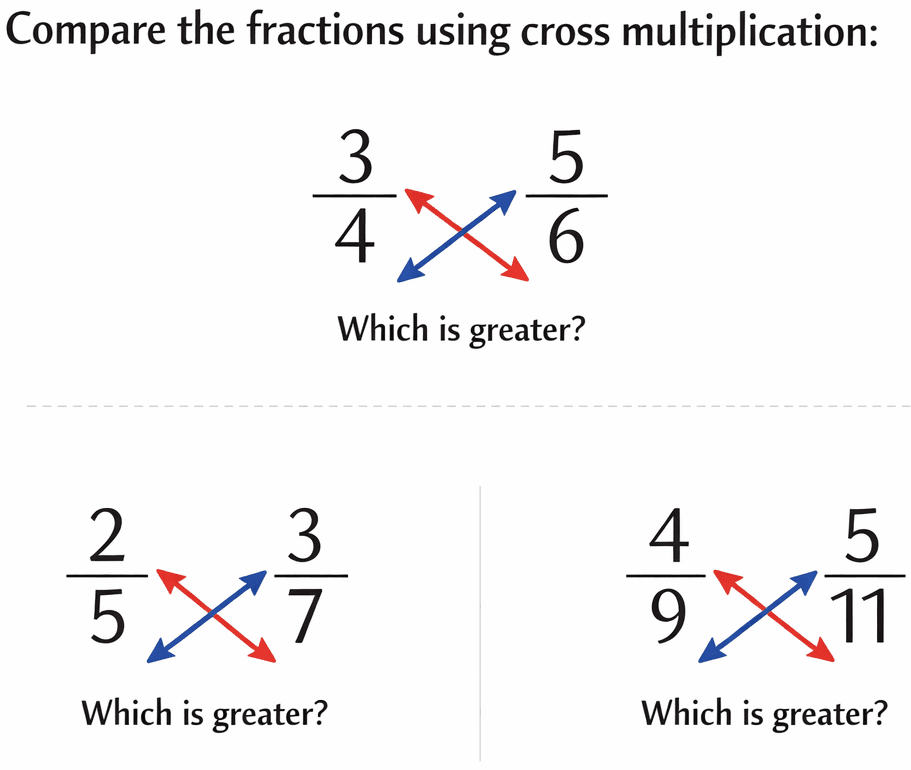
Examples shown in the screenshots:
\(\frac{3}{4}\) and \(\frac{5}{6}\) — Which is greater?
\(\frac{2}{5}\) and \(\frac{3}{7}\) — Which is greater?
\(\frac{4}{9}\) and \(\frac{5}{11}\) — Which is greater?
These examples teach students how to use the butterfly method to compare fractions by cross-multiplying.
Step-by-Step Solution / Explanation
Step 1: Understand how the butterfly method works
To use the butterfly method, multiply diagonally across the two fractions.
For \(\frac{a}{b}\) and \(\frac{c}{d}\):
Compare \(a \times d\) with \(c \times b\).
The fraction with the bigger cross-product is the greater fraction.
Step 2: Compare \(\frac{3}{4}\) and \(\frac{5}{6}\)
Cross-multiply:
\(3 \times 6 = 18\)
\(5 \times 4 = 20\)
Since \(20 > 18\), we know:
\(\frac{5}{6} > \frac{3}{4}\)
So, the greater fraction is \(\frac{5}{6}\).
Step 3: Compare \(\frac{2}{5}\) and \(\frac{3}{7}\)
Cross-multiply:
\(2 \times 7 = 14\)
\(3 \times 5 = 15\)
Since \(15 > 14\), we know:
\(\frac{3}{7} > \frac{2}{5}\)
So, the greater fraction is \(\frac{3}{7}\).
Step 4: Compare \(\frac{4}{9}\) and \(\frac{5}{11}\)
Cross-multiply:
\(4 \times 11 = 44\)
\(5 \times 9 = 45\)
Since \(45 > 44\), we know:
\(\frac{5}{11} > \frac{4}{9}\)
So, the greater fraction is \(\frac{5}{11}\).
Step 5: Write the conclusion clearly
The butterfly method helps us compare fractions quickly:
- \(\frac{5}{6}\) is greater than \(\frac{3}{4}\)
- \(\frac{3}{7}\) is greater than \(\frac{2}{5}\)
- \(\frac{5}{11}\) is greater than \(\frac{4}{9}\)
✅ Final Idea: Use cross multiplication to compare the fractions. The side with the larger product gives the greater fraction.
Key Concepts Students Must Know
- The butterfly method is another name for cross multiplication when comparing two fractions.
- For \(\frac{a}{b}\) and \(\frac{c}{d}\), compare \(a \times d\) and \(c \times b\).
- If the cross-products are equal, then the fractions are equal.
- This method is especially useful when the fractions have different denominators.
- You do not need to find equivalent fractions first if you use the butterfly method correctly.
Exam Tips / Common Mistakes
Exam Tips
- Draw imaginary butterfly wings across the fractions to remember which numbers to multiply.
- Always compare the two cross-products carefully before deciding the answer.
- Keep the greater-than sign correct after comparing the products.
- Use the butterfly method when the denominators are different and mental comparison is not obvious.
Common Mistakes
- Comparing only the numerators and ignoring the denominators.
- Comparing only the denominators and making the wrong conclusion.
- Multiplying the wrong pair of numbers.
- Finding the larger cross-product but choosing the wrong fraction at the end.
Parent Insight
The butterfly method builds confidence in fraction comparison because it gives children a clear step-by-step strategy. Instead of guessing which fraction is greater, students learn to prove their answer using multiplication. This is very useful for PSLE Maths, where accuracy in fractions is important.
Conclusion
The butterfly method is a fast and reliable way to compare fractions. By cross-multiplying, students can quickly decide which fraction is greater without converting to decimals. In the examples shown, \(\frac{5}{6}\), \(\frac{3}{7}\), and \(\frac{5}{11}\) are the greater fractions in their pairs.
Visit our PSLE Maths homepage: Click Here…
Read more PSLE Maths worked examples here: Click Here…
Start here (limited slots weekly):
Free Trial: Click Here…
Enroll: Click Here…
Explore our main tuition brand approach here: Click Here… .