Introduction
Many students feel nervous when they see long division questions, especially under exam pressure. But with the right division tricks, some questions can be solved much faster and with less stress.
In this PSLE Maths topic, we look at two useful shortcuts: dividing by \(5\) and dividing by \(25\). These methods are simple, logical, and helpful for students who want to improve speed and confidence during revision and exams.
Once students understand why these division tricks work, division starts to feel much less scary.
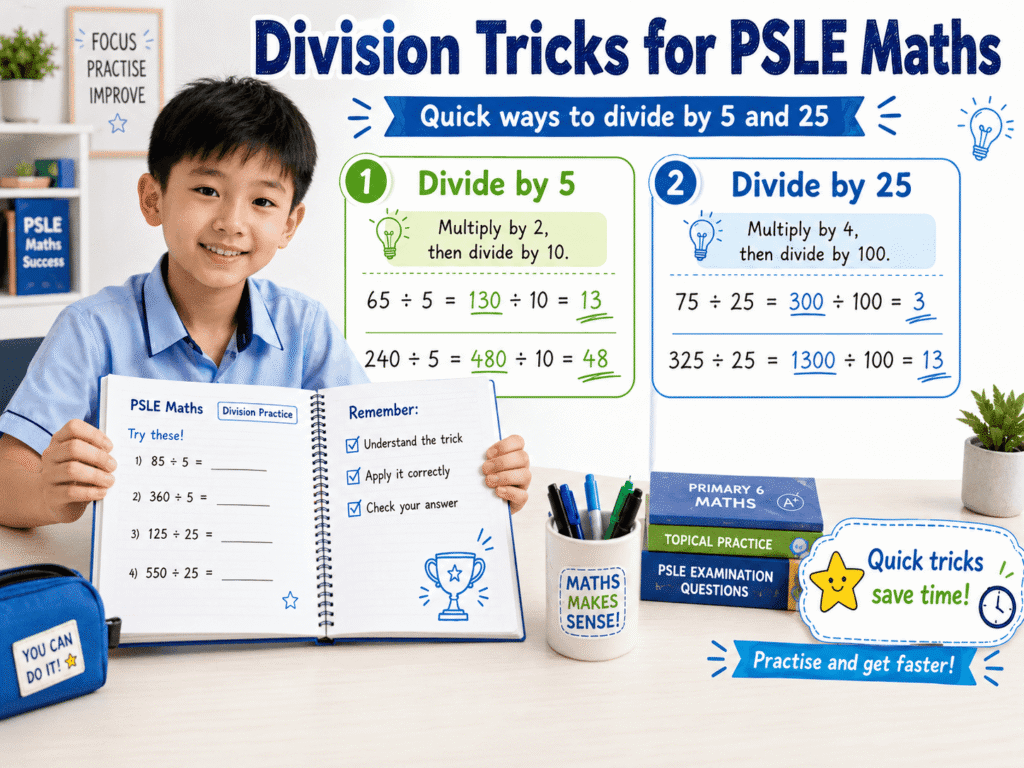
The Question / Scenario Explanation
Source: Division doesn’t have to feel so scary
The screenshots show a helpful reminder that students do not always need to rely on long division for every question. Some division questions can be simplified using number relationships.
For example:
- To divide by \(5\), students can multiply by \(2\), then divide by \(10\).
- To divide by \(25\), students can multiply by \(4\), then divide by \(100\).
These are useful division tricks because they turn a harder division step into a simpler calculation with numbers like \(10\) and \(100\).
Step-by-Step Solution / Explanation
Step 1: Understand the Trick for Dividing by 5
To divide a number by \(5\), we can multiply the number by \(2\), then divide by \(10\).
This works because:
\( 5 \times 2 = 10 \)
So instead of dividing directly by \(5\), we turn it into division by \(10\), which is easier to do mentally.
Example:
\( 120 \div 5 \)
Multiply \(120\) by \(2\):
\( 120 \times 2 = 240 \)
Then divide by \(10\):
\( 240 \div 10 = 24 \)
So,
\( 120 \div 5 = 24 \)
Step 2: Understand Why It Works
We are not changing the value of the question unfairly. We are simply using an equivalent method.
\( 120 \div 5 = \frac{120}{5} \)
If we multiply both the numerator and denominator by \(2\), we get:
\( \frac{120 \times 2}{5 \times 2} = \frac{240}{10} = 24 \)
This makes the method mathematically correct and easy to explain in class or during revision.
Step 3: Use the Trick for Dividing by 25
To divide a number by \(25\), we can multiply the number by \(4\), then divide by \(100\).
This works because:
\( 25 \times 4 = 100 \)
Example:
\( 300 \div 25 \)
Multiply \(300\) by \(4\):
\( 300 \times 4 = 1200 \)
Then divide by \(100\):
\( 1200 \div 100 = 12 \)
So,
\( 300 \div 25 = 12 \)
Step 4: Apply the Method Carefully
These division tricks are especially useful for mental maths and faster exam working, but students must still apply them carefully.
For dividing by \(5\):
- Multiply by \(2\)
- Then divide by \(10\)
For dividing by \(25\):
- Multiply by \(4\)
- Then divide by \(100\)
Students should always follow the steps in the correct order.
Step 5: Try Another Quick Example
Example \(1\):
\( 85 \div 5 \)
\( 85 \times 2 = 170 \)
\( 170 \div 10 = 17 \)
So,
\( 85 \div 5 = 17 \)
Example \(2\):
\( 200 \div 25 \)
\( 200 \times 4 = 800 \)
\( 800 \div 100 = 8 \)
So,
\( 200 \div 25 = 8 \)
Key Concepts Students Must Know
- Division can be simplified: Not every division question needs long division.
- Equivalent calculations matter: Multiplying the number and the divisor in a suitable way can make the question easier.
- Dividing by \(10\) and \(100\) is easier: Students can use place value knowledge to work faster.
- Number relationships are useful: Since \(5 \times 2 = 10\) and \(25 \times 4 = 100\), these shortcuts are reliable.
- Mental maths helps in exams: Good division tricks save time and improve confidence.
Exam Tips / Common Mistakes
Exam Tips
- Look out for friendly divisors like \(5\), \(25\), \(50\), and \(100\).
- Use these division tricks when they make the calculation faster and clearer.
- Write one or two working steps neatly so you can check your method.
- Practise mental maths regularly so the shortcut becomes natural.
- Always estimate your answer to see whether it makes sense.
Common Mistakes
- Multiplying by \(2\) or \(4\) but forgetting to divide by \(10\) or \(100\).
- Using the trick without understanding why it works.
- Placing decimal points wrongly when dividing by \(10\) or \(100\).
- Rushing and making careless errors in simple multiplication.
- Assuming all division questions have the same shortcut.
Students should remember that division tricks are tools to make thinking easier, not a replacement for careful checking.
Parent Insight
Many parents worry when their child seems afraid of division. Often, the issue is not that the child cannot do Maths. It is that they have not yet seen simpler and more intuitive methods.
When students learn shortcuts like dividing by \(5\) and \(25\), they begin to see patterns in numbers. This builds number sense, reduces fear, and helps them become more flexible problem-solvers.
At the PSLE level, confidence matters a lot. A child who feels calm and capable is more likely to attempt questions carefully and perform better during tests.
Conclusion
Division does not always have to be done the long way. By learning smart and simple methods, students can solve questions faster and with more confidence.
These division tricks for dividing by \(5\) and \(25\) are practical, easy to remember, and highly useful for PSLE Maths revision. The more students practise them, the more natural they become.
Visit our homepage: Click Here…
Read more on our blog: Click Here…
Start here (limited slots weekly):
Free Trial: Click Here…
Enrol: Click Here…
Explore our main tuition brand approach here: Click Here… .