Introduction
This cards comparison question is a good primary Maths problem because it combines two ideas in one: “fewer than” and “times as many”. Many students get the first step right but forget to use that result for the second step. Once the relationship is written clearly, this cards comparison question becomes much easier to solve.
The Question / Scenario Explanation
Source: P3 TAO NAN 2024 Term 1
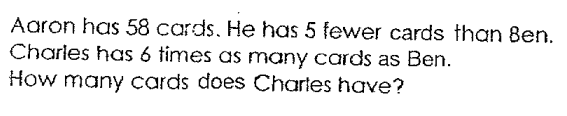
Aaron has \(58\) cards. He has \(5\) fewer cards than Ben. Charles has \(6\) times as many cards as Ben. How many cards does Charles have?
Step-by-Step Solution / Explanation
Step 1: Find how many cards Ben has
The question says Aaron has \(5\) fewer cards than Ben.
This means Ben has \(5\) more cards than Aaron.
So:
\(58 + 5 = 63\)
Ben has \(63\) cards.
Step 2: Find how many cards Charles has
Charles has \(6\) times as many cards as Ben.
So we multiply Ben’s number of cards by \(6\):
\(63 \times 6 = 378\)
So Charles has \(378\) cards.
✅ Final Answer: \(378\) cards
Step 3: Quick check
If Ben has \(63\) cards, then Aaron having \(5\) fewer means:
\(63 – 5 = 58\)
This matches the question.
If Charles has \(6\) times as many as Ben, then:
\(63 \times 6 = 378\)
So the cards comparison question is solved correctly.
Key Concepts Students Must Know
- In a cards comparison question, words like “fewer than” and “times as many” must be read carefully.
- If A has fewer than B, then B has more than A.
- “Times as many” means multiplication.
- When there are two comparison steps, solve them in the correct order.
Exam Tips / Common Mistakes
Exam Tips
- Underline the comparison phrases “5 fewer than Ben” and “6 times as many as Ben”.
- Find Ben’s number first before working out Charles’s number.
- For this cards comparison question, do not jump straight to multiplying \(58\) by \(6\).
- Check your answer by working backwards from Ben to Aaron.
Common Mistakes
- Subtracting \(5\) from \(58\) instead of adding \(5\) to find Ben’s cards.
- Multiplying Aaron’s \(58\) by \(6\) instead of using Ben’s correct value.
- Forgetting that Charles is compared to Ben, not Aaron.
- Stopping after finding Ben’s \(63\) cards without completing the second step.
Parent Insight
This cards comparison question is useful because it trains children to process comparison language carefully before calculating. Many pupils can do addition and multiplication, but they lose marks when a problem has two linked relationships. Questions like this build strong reading habits and clearer step-by-step thinking for future PSLE problem sums.
Conclusion
To solve this cards comparison question, we first found Ben’s cards by adding \(5\) to Aaron’s \(58\): \(58 + 5 = 63\). Then we found Charles’s cards by multiplying Ben’s amount by \(6\): \(63 \times 6 = 378\). So Charles has \(378\) cards.
Visit our PSLE Maths homepage: Click Here…
Read more PSLE Maths worked examples here: Click Here…
Start here (limited slots weekly):
Free Trial: Click Here…
Enroll: Click Here…
Explore our main tuition brand approach here: Click Here… .