Introduction
This monthly savings question is a useful PSLE-style word problem that tests part-whole thinking and equal sharing. Many students know they must use subtraction and division, but they get confused about which step comes first. Once the information is arranged clearly, this monthly savings question becomes very manageable.
The Question / Scenario Explanation
Source: P4 NAN HUA 2022 Term 1
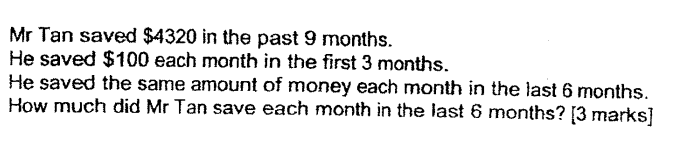
Mr Tan saved \(\$4320\) in the past \(9\) months.
He saved \(\$100\) each month in the first \(3\) months.
He saved the same amount of money each month in the last \(6\) months.
How much did Mr Tan save each month in the last \(6\) months?
Step-by-Step Solution / Explanation
Step 1: Find how much Mr Tan saved in the first 3 months
He saved \(\$100\) each month for \(3\) months.
\(100 \times 3 = 300\)
So, Mr Tan saved \(\$300\) in the first \(3\) months.
Step 2: Find how much was saved in the last 6 months altogether
The total savings for all \(9\) months was \(\$4320\).
Subtract the amount from the first \(3\) months:
\(4320 – 300 = 4020\)
So, Mr Tan saved \(\$4020\) in the last \(6\) months altogether.
Step 3: Find how much he saved each month in the last 6 months
He saved the same amount each month in the last \(6\) months, so divide equally:
\(4020 \div 6 = 670\)
✅ Final Answer: \(\$670\)
Step 4: Quick check
If he saved \(\$670\) each month for \(6\) months, then:
\(670 \times 6 = 4020\)
Add the first \(3\) months:
\(4020 + 300 = 4320\) ✅
This matches the total, so the monthly savings question is solved correctly.
Key Concepts Students Must Know
- In a monthly savings question, separate the total into known and unknown parts first.
- Use multiplication when the same amount is saved each month for several months.
- Use subtraction to remove the known part from the total.
- Use division when the remaining amount is shared equally across several months.
Exam Tips / Common Mistakes
Exam Tips
- Underline the time periods: first \(3\) months and last \(6\) months.
- Find the total for the known part before working on the unknown part.
- For this monthly savings question, use subtraction before division.
- Do a final check by adding both parts back to the total.
Common Mistakes
- Dividing \(\$4320\) by \(6\) immediately without removing the first \(3\) months.
- Forgetting that \(\$100\) was saved for \(3\) months, so the first part is \(\$300\), not \(\$100\).
- Using \(9\) instead of \(6\) in the last step.
- Not checking whether the final answer gives a total of \(\$4320\).
Parent Insight
This monthly savings question strengthens an important upper primary skill: breaking a word problem into smaller parts before solving. Many children rush into one operation and get stuck, but questions like this train them to identify the known amount, the remaining amount, and the equal groups clearly. This habit is very helpful for PSLE problem sums later on.
Conclusion
To solve this monthly savings question, we first found the savings in the first \(3\) months: \(\$100 \times 3 = \$300\). Then we subtracted this from the total: \(\$4320 – \$300 = \$4020\). Finally, we divided \(\$4020\) by \(6\) to get \(\$670\). So Mr Tan saved \(\$670\) each month in the last \(6\) months.
Visit our PSLE Maths homepage: Click Here…
Read more PSLE Maths worked examples here: Click Here…
Start here (limited slots weekly):
Free Trial: Click Here…
Enroll: Click Here…
Explore our main tuition brand approach here: Click Here… .